


What is Melanotan-2 (MT-II)?
The melanocortin peptide studied for tanning and sexual function
Disclaimer: Information provided is for research and educational purposes only. Melanotan-II is not approved by the FDA or EMA for human or cosmetic use.
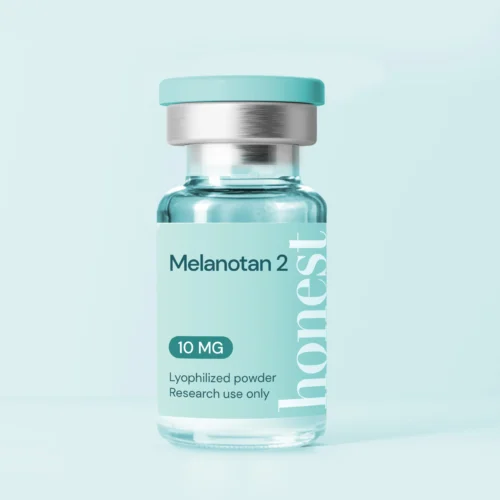
Introduction:
Melanotan-2 (MT-II), often called the “tanning peptide,” is a synthetic analog of the natural α-melanocyte-stimulating hormone (α-MSH). It was developed in the 1980s to explore sunless tanning and skin-protection effects.¹ As a melanocortin receptor agonist, Melanotan-II promotes skin pigmentation and has been studied for its influence on sexual function, energy balance, and UV protection.¹ ² ³ ⁴ ⁸ ⁹
MT-II Fast Facts
- Class: Melanocortin receptor agonist (α-MSH analog)
- Design: Cyclic heptapeptide (lactam bridge) engineered for potency/stability
- Primary targets: MC1R (pigmentation), central MC3R/MC4R (sexual function, energy balance).⁸
- Most studied effects: Increased pigmentation; erectogenic response in ED cohorts; nausea/yawning common.¹

Melanotan-2 Chemical Structure
What exactly does MT-II do?
MT-II stimulates melanogenesis via MC1R on melanocytes → darker pigmentation following short subcutaneous dosing.¹
In the CNS, MT-II can trigger erections without sexual stimulation, pointing to central melanocortin circuitry (hypothalamic and spinal sites).²
Discovery & Research Milestones
- Originated at the University of Arizona in the 1980s, where researchers were exploring sunless tanning agents.¹
- Built as a short, stable analog of α-MSH, improving its half-life and activity compared to the natural hormone.²
- Early studies tested Melanotan-2 in skin pigmentation disorders and sexual dysfunction, but it never achieved regulatory approval.³
| Year | Study & Source | Key Finding |
| 1996 | Dorr RT et al. | Visible tanning after low-dose MT-II; common side effects include nausea & yawning. Recommended 0.025 mg/kg. |
| 1998 | Wessells H et al. | First studies on use for erectile dysfunction. MT-2 induces erections without erotic stimuli |
| 2000-2003 | Wessells H et al. | Mechanism established: central melanocortin pathways (hypothalamus and spinal cord) mediate MT-II-induced erection. |
| 2003-2004 | PT-141 program | MT-II signal translated into PT-141/bremelanotide; early RCTs show dose-dependent erectile activity and acceptable tolerance. |
A Closer Look: What the Research Shows
- Skin Pigmentation (Tanning)
A single-blind, alternating-day phase-I trial found visible tanning after five low doses and recommended 0.025 mg/kg for future studies; common AEs were nausea, yawning, somnolence. - Erectile physiology
A double-blind, placebo-controlled crossover study showed robust erections (average of 38 min of >80% rigidity) with 0.025 mg/kg MT-II; nausea/yawning increased vs. placebo. - Development of PT-141
The erectogenic signal from MT-II led to development of PT-141/bremelanotide (a related melanocortin agonist)
Research Applications
- Pigmentation disorders: Investigated for use in vitiligo and erythropoietic protoporphyria.²
- Skin protection: Studied for potential reduction of UV-related skin damage.³
- Sexual function: Explored as a treatment for erectile dysfunction and female sexual arousal disorder. ³
Regulatory Status
- MT-II: Not approved for tanning or sexual function
- Afamelanotide (MT-I) is approved for EPP (EU 2014; US 2019); long-term safety/PK are reviewed separately.
Summary
Melanotan-2 is a potent melanocortin agonist that darkens skin (via MC1R) and triggers erections by acting on central melanocortin pathways. Controlled early trials defined doses and common AEs; the erectogenic signal catalyzed development of bremelanotide.
FAQs About Melanotan-2
Is Melanotan-2 FDA-approved?
No, it is not approved by the FDA or EMA and is considered a research chemical.
What does Melanotan-2 do?
It increases melanin production in the skin by activating melanocortin receptors, leading to darker pigmentation.
What was Melanotan-2 originally developed for?
It was developed as a tanning agent and studied for pigmentation disorders and sexual dysfunction.
Related Articles
Related Articles
References
- Dorr RT, Lines R, Levine N, et al. Evaluation of melanotan-II, a superpotent cyclic melanotropic peptide in a pilot phase I clinical study. Life Sci. 1996;58(20):1777-1784. https://pubmed.ncbi.nlm.nih.gov/8637402/
- Wessells H, Fuciarelli K, Hansen J, et al. Synthetic melanotropic peptide initiates erections in men with psychogenic erectile dysfunction: double-blind, placebo-controlled crossover study. J Urol. 1998;160(2):389-393. https://pubmed.ncbi.nlm.nih.gov/9679884/
- Vemulapalli R, Kurosawa M, Killinger J, et al. Activation of central melanocortin receptors by melanotan-II (Ac-Nle-c[Asp-His-D-Phe-Arg-Trp-Lys]-NH₂) results in penile erection in rats. Neuroscience. 2001;106(3):547-552. https://pubmed.ncbi.nlm.nih.gov/11591452/
- Wessells H, Hruby V J, Hackett J, et al. Central melanocortin pathways mediate the erectogenic effects of melanotan-II in animal models. J Urol. 2003;170(6 Pt 1):S. (Abstract and mechanistic report.) https://pubmed.ncbi.nlm.nih.gov/14665870/
- Rosen R C, Diamond L E, Earle D C, Shadiack A M, Molinoff P B. Evaluation of the safety, pharmacokinetics and pharmacodynamics of intranasal PT-141, a melanocortin receptor agonist, in healthy males and patients with erectile dysfunction. J Sex Med. 2004;1(3):193-202. https://pubmed.ncbi.nlm.nih.gov/14999221/
- Diamond L E, Earle D C, Garcia W D, Spana C. Double-blind, placebo-controlled evaluation of the safety, efficacy and dose response of subcutaneous PT-141 in men with erectile dysfunction. Int J Impot Res. 2004;16(4):353-360. https://pubmed.ncbi.nlm.nih.gov/14963471/
- Hadley M E. Discovery that a melanocortin regulates sexual functions in male and female humans. Peptides. 2005;26(10):1687-1691. https://pubmed.ncbi.nlm.nih.gov/15996790/
- Cai M, Hruby V J. Melanocortin receptors: their structure, function, and ligands. Peptides. 2016;88:3-18. https://pubmed.ncbi.nlm.nih.gov/27746082/ (Open access PMC article: https://pmc.ncbi.nlm.nih.gov/articles/PMC5999398/)
- Mun Y, Jeon J H, Lee E S, et al. Melanocortin-1 receptor (MC1R): pharmacology and therapeutic prospects. Pharmaceutics. 2023;15(7):1814. https://pmc.ncbi.nlm.nih.gov/articles/PMC10418475/
- Hjuler K F, Brøgger-Mikkelsen M, Pedersen S, et al. Melanoma associated with the use of melanotan-II. Acta Derm Venereol. 2014;94(1):115-116. https://pubmed.ncbi.nlm.nih.gov/24355990/
- DermNet NZ. Melanotan II – Uses and side effects. (Clinical dermatology resource.) https://dermnetnz.org/topics/melanotan-ii
- Minder E I, Schneider-Yaniv L, Schneider-Yaniv Z. Pharmacokinetics and pharmacodynamics of afamelanotide, a melanocortin 1 receptor agonist, in humans. Clin Pharmacokinet. 2017;56(8):815-826. https://pubmed.ncbi.nlm.nih.gov/28063031/
