


What Is Semax?
The ACTH-Derived Peptide Studied in Neurotrophic and Neurological Research
Disclaimer: Information provided is for research and educational purposes only. Semax is not approved by the FDA for therapeutic use in the United States. Its regulatory status may differ internationally.
Introduction
Semax is a synthetic peptide derived from a short region of adrenocorticotropic hormone, or ACTH. It consists of seven amino acids and is commonly described as an analog of the ACTH (4-10) fragment.¹²
Its sequence is:
Met-Glu-His-Phe-Pro-Gly-Pro
Semax combines the first four amino acids of ACTH (4-10) with the tripeptide Pro-Gly-Pro, or PGP. This modification was designed to create a more stable peptide while preserving the neurological activity associated with short ACTH fragments.¹²
Unlike full-length ACTH, Semax was not developed to stimulate the adrenal cortex or reproduce ACTH’s hormonal effects. Research has instead focused on its potential influence on neurotrophin signaling, neural plasticity, neurotransmitter systems, cerebral ischemia, and inflammatory responses in the nervous system.³–⁷
Semax Fast Facts
| Property | Details |
| Class | Synthetic regulatory heptapeptide |
| Peptide sequence | Met-Glu-His-Phe-Pro-Gly-Pro |
| Structural origin | ACTH (4-7) fragment combined with Pro-Gly-Pro |
| Common description | Synthetic analog of ACTH (4-10) |
| Main research areas | Neurotrophin signaling, neural plasticity, cognition, cerebral ischemia, and neuroinflammation |
| Frequently studied pathways | BDNF/TrkB signaling, dopamine and serotonin systems, and ischemia-related gene expression |
| Hormonal activity | Designed without the primary corticotropic activity of full-length ACTH |
| Evidence base | Primarily cell and animal research, with a smaller body of human studies |
| Key limitation | Its complete molecular mechanism has not been established |
| U.S. regulatory status | Not FDA-approved for therapeutic use |
Chemical Structure
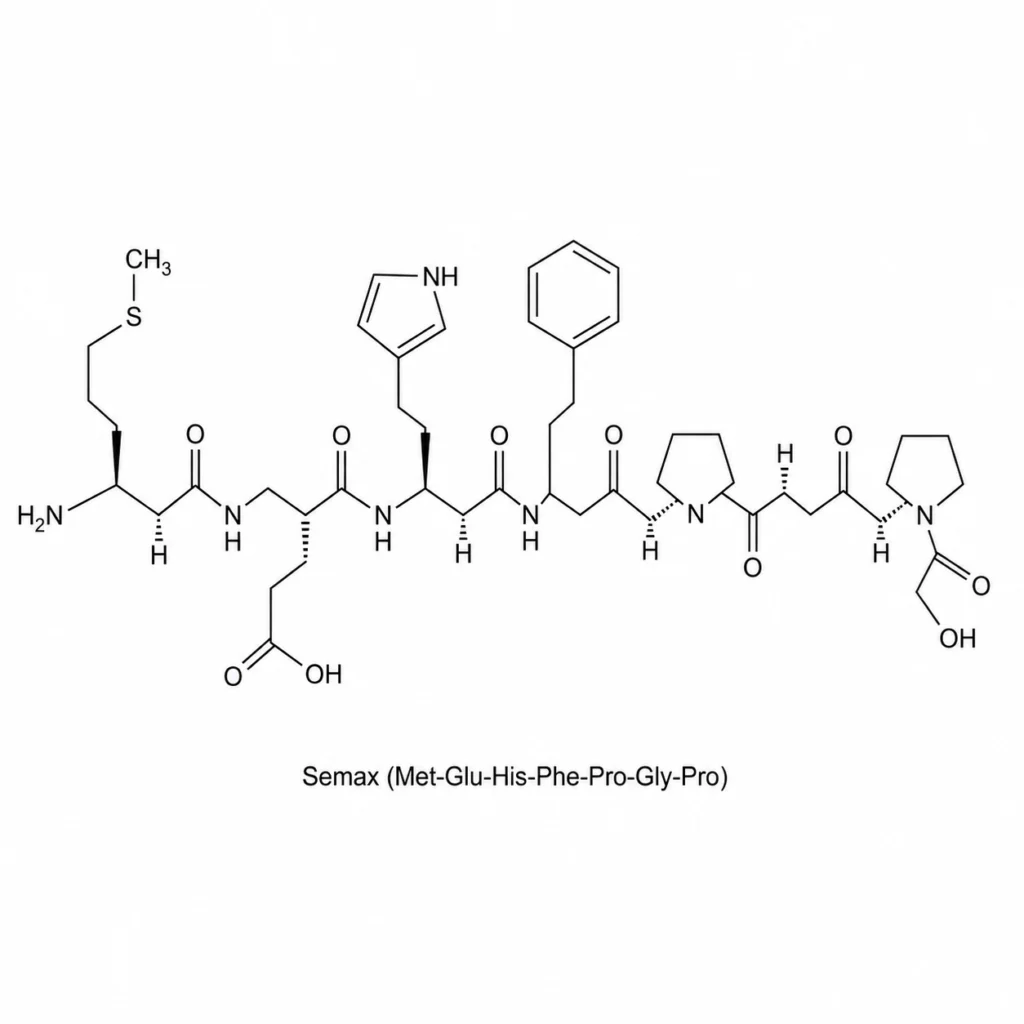
Semax is a linear peptide containing seven amino acids:
Met-Glu-His-Phe-Pro-Gly-Pro
The first four amino acids—Met-Glu-His-Phe—correspond to the ACTH (4-7) fragment. The final three amino acids form the Pro-Gly-Pro sequence.
Natural ACTH (4-10) has a different sequence:
Met-Glu-His-Phe-Arg-Trp-Gly
Semax retains the ACTH-derived four-amino-acid core but replaces the final Arg-Trp-Gly region with Pro-Gly-Pro. The PGP sequence was incorporated to improve resistance to enzymatic degradation and create a more stable research peptide.¹²
In simple terms, Semax can be described as:
ACTH (4-7) + Pro-Gly-Pro
Although Semax is derived from an ACTH sequence, it is not equivalent to full-length ACTH. ACTH is a 39-amino-acid endocrine hormone involved in adrenal glucocorticoid production. Semax is a much shorter synthetic peptide developed primarily for neurological research.
How Semax Works (In Brief)
Semax does not have one conclusively established receptor or mechanism that explains all of its reported effects.
Research suggests that it may influence several interconnected systems, including:
- Brain-derived neurotrophic factor, or BDNF
- The BDNF receptor TrkB
- Nerve growth factor, or NGF
- Dopamine and serotonin signaling
- Inflammatory gene expression
- Cellular responses to cerebral ischemia
Animal studies have reported changes in BDNF expression, TrkB signaling, monoamine activity, and genes involved in immune and vascular responses.³–⁷
The key point is that Semax appears to have a multi-pathway research profile rather than behaving as a conventional single-target receptor agonist.
Discovery & Research Milestones
The scientific background of Semax begins with research into short fragments of ACTH.
Researchers observed that certain ACTH fragments could affect learning, memory, and behavior in experimental models without producing the full adrenal effects of the complete hormone. However, natural ACTH fragments were rapidly broken down by enzymes.¹²
Semax was developed by combining the ACTH (4-7) sequence with Pro-Gly-Pro. This created a more stable peptide for investigating the neurological effects associated with ACTH-derived fragments.
| Year | Study & Source | Key Finding |
| 1970s–1980s | Early ACTH-fragment research | Short ACTH fragments were investigated for behavioral and neurological activity separate from full-length ACTH’s endocrine effects.¹ |
| 1991 | Potaman et al. | Compared the enzymatic degradation of ACTH (4-10) and Semax in rat blood and serum.² |
| 1997 | Gusev et al. | Reported findings from an early study of Semax in patients with acute ischemic stroke.⁸ |
| 2005 | Eremin et al. | Reported changes in dopaminergic and serotonergic systems in rodents.³ |
| 2006 | Dolotov et al. | Found changes in BDNF and TrkB expression in the rat hippocampus.⁴ |
| 2006 | Dolotov et al. | Reported specific binding and increased BDNF protein levels in the rat basal forebrain.⁵ |
| 2010 | Dmitrieva et al. | Studied neurotrophin and neurotrophin-receptor gene expression after cerebral ischemia.⁶ |
| 2014 | Medvedeva et al. | Identified changes in immune- and vascular-related gene expression in a rat ischemia model.⁷ |
| 2018 | Gusev et al. | Reported functional and BDNF-related findings during ischemic-stroke rehabilitation.⁹ |
| 2021 | Sudarkina et al. | Examined protein-expression changes in a rat model of cerebral ischemia-reperfusion.¹⁰ |
What Research Shows
Neurotrophin Signaling
One of the main areas of Semax research involves neurotrophins, a group of proteins that help regulate neuronal survival, development, adaptation, and synaptic plasticity.
Rodent studies have reported changes in BDNF levels, BDNF gene expression, and signaling through its receptor TrkB following Semax exposure.⁴⁵ Other research has examined possible effects on NGF and related neurotrophin receptors.⁶
These findings are one reason Semax is studied in models involving learning, memory, neural adaptation, and neurological recovery.
However, changes in BDNF or other molecular markers do not automatically demonstrate cognitive or therapeutic benefits in humans.
Cerebral Ischemia
A substantial portion of Semax research has involved cerebral ischemia, in which blood flow to part of the brain is reduced or interrupted.
In experimental models, Semax has been associated with changes in genes and proteins involved in:
- Neurotrophin signaling
- Inflammation
- Immune activity
- Vascular function
- Neurotransmission
- Cellular stress responses
Genome-wide studies suggest that Semax may affect broad biological networks rather than one isolated signaling pathway.⁷¹⁰
Some human studies have also examined Semax during acute ischemic stroke and neurological rehabilitation.⁸⁹ However, the human evidence remains more limited than the preclinical literature and has not been broadly replicated internationally.
Dopamine and Serotonin Systems
Semax has also been studied for its potential influence on monoamine neurotransmitters.
A rodent study reported changes in dopaminergic and serotonergic activity in several brain regions following Semax administration.³ Dopamine and serotonin are involved in processes such as attention, motivation, mood, movement, and cognitive performance.
These findings contribute to Semax’s reputation as a cognitive or “nootropic” research peptide. However, animal neurotransmitter findings do not establish that Semax reliably improves focus, memory, or mood in humans.
Inflammatory and Immune Signaling
Research in cerebral-ischemia models suggests that Semax may also influence inflammatory and immune-response pathways.
Studies have reported changes in chemokines, immunoglobulins, and other mediators involved in the brain’s response to injury.⁷ Additional work has found changes in several pro-inflammatory transcripts following experimental ischemia.
These results suggest that Semax’s research profile may involve both neuronal and neuroimmune processes.
More research is needed to determine how these molecular findings relate to meaningful outcomes.
Semax vs. ACTH
Semax is derived from ACTH, but the two peptides differ significantly in their structure and biological roles.
| Feature | Full-Length ACTH | Semax |
| Structure | 39-amino-acid peptide hormone | Seven-amino-acid synthetic peptide |
| Primary established target | Melanocortin 2 receptor | No single conclusively established target |
| Main biological role | Stimulates adrenal glucocorticoid production | Studied in neurological and neurotrophic signaling models |
| Corticotropic activity | Yes | Designed without the primary corticotropic activity of ACTH |
| Research focus | Endocrine and adrenal function | Neurotrophins, cognition, ischemia, neurotransmitters, and neuroinflammation |
The cleanest way to explain it: ACTH is an endocrine hormone that regulates adrenal activity, while Semax is a short ACTH-derived peptide developed for neurological research.
Semax vs. Natural ACTH (4-10)
Semax is commonly described as an ACTH (4-10) analog, but the two peptides are not identical.
Feature ACTH (4-10) Semax Sequence Met-Glu-His-Phe-Arg-Trp-Gly Met-Glu-His-Phe-Pro-Gly-Pro Number of amino acids Seven Seven Shared sequence ACTH (4-7) ACTH (4-7) Final three amino acids Arg-Trp-Gly Pro-Gly-Pro Origin Naturally occurring ACTH fragment Synthetic analog Stability Rapidly degraded Designed for improved enzymatic stability Both peptides share the same ACTH (4-7) core. Semax is distinguished by its Pro-Gly-Pro ending, which was added to improve stability.¹²
Research Limitations
The Semax evidence base includes decades of laboratory research, but it also has important limitations.
Most mechanistic findings come from:
- Rodent studies
- Cell-based experiments
- Experimental cerebral-ischemia models
- Gene-expression and protein-expression analyses
Human studies have been conducted, particularly in Russia, but the clinical literature is relatively small and has limited independent international replication.
Preclinical findings can help researchers understand possible biological pathways, but they cannot establish that Semax is safe or effective for treating a medical condition.
Semax is not FDA-approved for therapeutic use in the United States. Its long-term safety, optimal exposure, drug interactions, and complete adverse-effect profile have not been established through large, well-controlled clinical trials.
Summary
Semax is a synthetic seven-amino-acid peptide derived from the ACTH (4-7) sequence and extended with Pro-Gly-Pro.
It is commonly described as an ACTH (4-10) analog, although it differs from the natural fragment in its final three amino acids. The PGP sequence was added to improve peptide stability while preserving the neurological research profile associated with short ACTH fragments.¹²
Semax does not have one fully established molecular target. Research suggests that it may influence BDNF and other neurotrophins, dopamine and serotonin systems, inflammatory signaling, and cellular responses to cerebral ischemia.³–⁷
The strongest evidence remains preclinical. Human studies have produced preliminary findings in neurological and cognitive settings, but the clinical literature is limited and has not been broadly replicated.
Semax remains scientifically relevant because it provides a model for studying how stabilized ACTH-derived peptides may influence neural signaling without reproducing the primary hormonal activity of full-length ACTH.
FAQs About Semax
What is Semax?
Semax is a synthetic heptapeptide composed of the sequence Met-Glu-His-Phe-Pro-Gly-Pro. It combines the ACTH (4-7) fragment with Pro-Gly-Pro.
Is Semax the same as ACTH?
No. ACTH is a 39-amino-acid endocrine hormone that stimulates the adrenal cortex. Semax is a seven-amino-acid synthetic peptide derived from a small ACTH fragment.
Why is Semax called an ACTH (4-10) analog?
Semax and ACTH (4-10) share the same four-amino-acid ACTH (4-7) core. Semax replaces the final Arg-Trp-Gly sequence of ACTH (4-10) with Pro-Gly-Pro.
What is Semax used for in research?
Semax is studied in research involving neurotrophin signaling, BDNF and TrkB, neural plasticity, cerebral ischemia, neurotransmitter systems, cognition, and neuroinflammation.
How does Semax work?
Its complete mechanism has not been established. Research suggests that it may influence neurotrophin signaling, monoamine neurotransmitters, inflammatory mediators, and gene-expression networks involved in the brain’s response to stress and injury.
Does Semax affect BDNF?
Several rodent studies have reported changes in BDNF expression, BDNF protein levels, and TrkB signaling following Semax exposure. These findings do not establish that Semax reliably produces the same effects or related benefits in humans.
Is Semax a nootropic?
Semax is often described as a nootropic research peptide because it has been studied in cognitive and neurological models. Current evidence does not establish it as a proven cognitive enhancer.
Does Semax have hormonal effects like ACTH?
Semax was designed without the primary corticotropic activity of full-length ACTH. It is not intended to stimulate the adrenal cortex through the same established pathway as ACTH.
Has Semax been studied in humans?
Yes. Human studies have examined Semax in ischemic stroke, neurological rehabilitation, and cognitive settings. However, the clinical literature remains relatively limited.
Is Semax FDA-approved?
No. Semax is not FDA-approved for therapeutic use in the United States.
Related Articles
References
- Deigin VI, Poluektova EA, Beniashvili AG, Kozin SA, Poluektov YM. Development of peptide biopharmaceuticals in Russia. Pharmaceutics. 2022;14(4):716. https://pubmed.ncbi.nlm.nih.gov/35456550/
- Potaman VN, Alfeeva LY, Kamensky AA, Levitskaya NG, Nezavibatko VN. N-terminal degradation of ACTH (4-10) and its synthetic analog Semax by rat blood enzymes. Biochemical and Biophysical Research Communications. 1991;176(2):741–746. https://pubmed.ncbi.nlm.nih.gov/1851003/
- Eremin KO, Kudrin VS, Saransaari P, et al. Semax, an ACTH (4-10) analogue with nootropic properties, activates dopaminergic and serotoninergic brain systems in rodents. Neurochemical Research. 2005;30(12):1493–1500. https://pubmed.ncbi.nlm.nih.gov/16362768/
- Dolotov OV, Karpenko EA, Inozemtseva LS, et al. Semax, an analog of ACTH (4-10) with cognitive effects, regulates BDNF and TrkB expression in the rat hippocampus. Brain Research. 2006;1117(1):54–60. https://pubmed.ncbi.nlm.nih.gov/16996037/
- Dolotov OV, Karpenko EA, Seredenina TS, et al. Semax, an analogue of adrenocorticotropin (4-10), binds specifically and increases levels of brain-derived neurotrophic factor protein in rat basal forebrain. Journal of Neurochemistry. 2006;97(Suppl 1):82–86. https://pubmed.ncbi.nlm.nih.gov/16635254/
- Dmitrieva VG, Povarova OV, Skvortsova VI, Limborska SA, Myasoedov NF, Dergunova LV. Semax and Pro-Gly-Pro activate the transcription of neurotrophins and their receptor genes after cerebral ischemia. Cellular and Molecular Neurobiology. 2010;30(1):71–79. https://pubmed.ncbi.nlm.nih.gov/19633950/
- Medvedeva EV, Dmitrieva VG, Povarova OV, et al. The peptide Semax affects the expression of genes related to the immune and vascular systems in rat brain focal ischemia: genome-wide transcriptional analysis. BMC Genomics. 2014;15:228. https://pmc.ncbi.nlm.nih.gov/articles/PMC3987924/
- Gusev EI, Skvortsova VI, Chukanova EI. Effectiveness of Semax in the acute period of hemispheric ischemic stroke. Zhurnal Nevrologii i Psikhiatrii imeni S.S. Korsakova. 1997. https://pubmed.ncbi.nlm.nih.gov/11517472/
- Gusev EI, Martynov MY, Kostenko EV, Petrova LV, Bobyreva SN. The efficacy of Semax in the treatment of patients at different stages of ischemic stroke. Zhurnal Nevrologii i Psikhiatrii imeni S.S. Korsakova. 2018;118(3):61–68. https://pubmed.ncbi.nlm.nih.gov/29798983/
- Sudarkina OY, Filippenkov IB, Stavchansky VV, et al. Brain protein expression profile confirms the protective effect of the ACTH (4-7) PGP peptide Semax in a rat model of cerebral ischemia-reperfusion. International Journal of Molecular Sciences. 2021;22(12):6179. https://pmc.ncbi.nlm.nih.gov/articles/PMC8226508/
