


What Is Tesamorelin?
The Stabilized Growth Hormone–Releasing Hormone Analog Used to Study GH Signaling and Visceral Adipose Tissue
Disclaimer: Information provided is for research and educational purposes only. Tesamorelin is FDA approved as the active ingredient in prescription medication for reducing excess abdominal fat in adults with HIV-associated lipodystrophy. However, research-grade tesamorelin is not approved for human or veterinary use. Its regulatory status and approved uses may differ internationally.
Introduction
Tesamorelin is a synthetic analog of human growth hormone–releasing hormone, also called growth hormone–releasing factor or GHRF. GHRH is a peptide produced in the hypothalamus that signals the pituitary gland to synthesize and release growth hormone.¹
Tesamorelin contains the full 44-amino-acid sequence of human GHRH, along with an N-terminal modification designed to improve stability compared with the natural hormone. By activating GHRH receptors on pituitary somatotroph cells, tesamorelin stimulates endogenous growth hormone release and downstream insulin-like growth factor 1 signaling.¹²
Unlike many peptides discussed primarily in research settings, tesamorelin is also the active ingredient in an FDA-approved prescription drug. It was approved in the United States in 2010 for reducing excess abdominal fat in adults with HIV-associated lipodystrophy. It is not approved for general weight-loss management.¹³
Note: FDA approval applies to the regulated prescription drug and its specific indication. Research-grade tesamorelin sold outside the approved pharmaceutical supply chain is not equivalent to an FDA-approved medication and is intended for laboratory research only.
Tesamorelin Fast Facts
| Property | Details |
| Class | Growth hormone–releasing hormone analog |
| Development Name | TH9507 |
| Peptide Length | 44 amino acids |
| Primary Target | GHRH receptor on pituitary somatotroph cells |
| Main Pathway | GHRHR activation → endogenous GH release → downstream IGF-1 signaling |
| Main Research Uses | GH-axis signaling, visceral-adipose-tissue biology, body-composition research, lipid metabolism, and hepatic-fat research |
| Structural Feature | N-terminal trans-3-hexenoyl modification designed to improve stability |
| FDA-Approved Context | Reduction of excess abdominal fat in HIV-infected adults with lipodystrophy |
| Important Limitation | Not approved as a general weight-loss medication |
| Not the same as GH | Tesamorelin stimulates the pituitary to release endogenous growth hormone rather than supplying growth hormone directly |
Chemical Structure
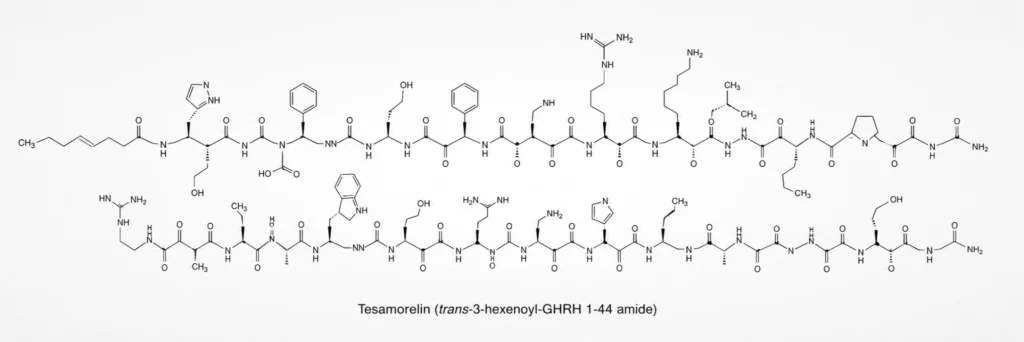
Tesamorelin is based on the complete 44-amino-acid sequence of human GHRH. A trans-3-hexenoyl group—a six-carbon chain containing a double bond—is attached to the tyrosine residue at the peptide’s N-terminus.¹
This modification was developed to increase resistance to enzymatic degradation and extend biological activity compared with unmodified human GHRH. Tesamorelin is commonly prepared as an acetate salt and has a molecular weight of approximately 5,135.9 daltons as a free-base equivalent.¹
In simple terms, tesamorelin preserves the receptor-binding sequence of natural GHRH while adding an N-terminal modification that makes the peptide more stable for experimental and pharmaceutical use.
How Tesamorelin Works (In Brief)
Tesamorelin works by mimicking the signaling activity of natural GHRH. It binds to GHRH receptors on somatotroph cells in the anterior pituitary, stimulating the synthesis and release of endogenous growth hormone.¹²
Growth hormone then acts on tissues throughout the body and supports the production of insulin-like growth factor 1, particularly in the liver. GH and IGF-1 participate in multiple pathways involving tissue growth, metabolism, lipid turnover, and body composition.
The key point is that tesamorelin is not growth hormone. It acts upstream of GH by activating the body’s own hypothalamic-pituitary signaling pathway. Research indicates that tesamorelin can increase both basal and pulsatile GH secretion rather than providing a continuous external supply of growth hormone.²
For a more detailed explanation of its receptor signaling and downstream pathways, see: How Does Tesamorelin Work?
Discovery & Research Milestones
The scientific background of tesamorelin begins with the identification of human GHRH in the early 1980s. Researchers isolated and characterized the natural hypothalamic peptide responsible for stimulating pituitary growth hormone release.⁴⁵
Native GHRH has limited stability in circulation, leading researchers to develop modified analogs with longer biological activity. Tesamorelin, initially identified by the development name TH9507, retained the full GHRH sequence while adding an N-terminal stabilizing modification.
| Year | Study & Source | Key Finding |
| 1982 | Rivier J et al., Nature | Characterized human growth hormone–releasing factor isolated from pancreatic tumor tissue.⁴ |
| 1982 | Guillemin R et al., Science | Independently identified and confirmed the human GHRH sequence.⁵ |
| 2005 | Falutz J et al., AIDS | A dose-ranging study of TH9507 found increased IGF-1 and changes in truncal fat and metabolic measurements in adults with HIV-associated abdominal-fat accumulation.⁶ |
| 2007 | Falutz J et al., New England Journal of Medicine | A larger randomized trial reported reduced visceral adipose tissue following 26 weeks of tesamorelin treatment in the studied HIV population.⁷ |
| 2008 | Falutz J et al., AIDS | Extension research examined the maintenance and long-term safety of visceral-fat changes through 52 weeks.⁸ |
| 2010 | Falutz J et al., JCEM | A pooled analysis of two Phase 3 trials reported a 15.4% treatment effect on visceral adipose tissue at 26 weeks.⁹ |
| 2010 | U.S. FDA approval | Tesamorelin was approved for reducing excess abdominal fat in HIV-infected adults with lipodystrophy.¹³ |
| 2014 | Stanley TL et al., JAMA | Preliminary research examined tesamorelin’s effects on both visceral and hepatic fat in adults with HIV.¹⁰ |
| 2019 | Stanley TL et al., The Lancet HIV | A randomized study further investigated hepatic-fat and fibrosis-related outcomes in HIV-associated nonalcoholic fatty liver disease.¹¹ |
What Research Shows
Growth Hormone and IGF-1 Stimulation
Tesamorelin acts at the pituitary rather than supplying growth hormone directly. GHRH-receptor activation stimulates endogenous GH release, which subsequently increases downstream IGF-1 signaling.¹²
Early dose-ranging research reported dose-related increases in IGF-1, and later pharmacokinetic and pharmacodynamic studies characterized changes in both GH and IGF-1 following repeated tesamorelin exposure.²⁶
This makes tesamorelin useful for studying how controlled GHRH-receptor stimulation affects the broader somatotropic axis.
Visceral Adipose Tissue Research
The largest clinical evidence base for tesamorelin involves visceral adipose tissue in adults with HIV-associated lipodystrophy.
Visceral adipose tissue is the fat stored within the abdominal cavity around internal organs. It is distinct from subcutaneous fat, which is stored directly beneath the skin.
In pooled Phase 3 research involving more than 800 participants, tesamorelin produced a significant reduction in visceral adipose tissue compared with placebo while having relatively little effect on abdominal subcutaneous fat.⁹
These findings formed the basis of tesamorelin’s approved prescription indication. However, they should not be generalized to routine obesity treatment or to populations that were not included in the clinical trials.
Weight and Fat Distribution Are Not the Same
Tesamorelin is not classified as a general weight-loss medication. Its prescribing information describes it as weight neutral and specifically limits its approved use to reducing excess abdominal fat associated with HIV lipodystrophy.¹
This distinction is important. A compound may alter a particular fat compartment or body-composition measurement without producing a corresponding reduction in total body weight.
Broader Metabolic Research
Additional studies have explored tesamorelin in relation to triglycerides, hepatic fat, liver-related biomarkers, body composition, and other GH-dependent pathways.⁷⁹⁻¹¹
These areas remain scientifically relevant, but results from investigational studies should not be interpreted as additional FDA-approved uses.
For a study-by-study discussion of these outcomes, see: Tesamorelin Benefits: What Research Shows.
Tesamorelin vs. CJC-1295
Tesamorelin and CJC-1295 are both synthetic GHRH analogs, but they differ in structure, duration strategy, clinical development, and regulatory status.
Tesamorelin is based on the complete 44-amino-acid GHRH sequence and uses an N-terminal hexenoyl modification to improve stability. CJC-1295-related compounds are generally based on the shorter active 1–29 region of GHRH.
CJC-1295 with DAC also contains an albumin-binding drug-affinity-complex modification designed to produce prolonged exposure. Tesamorelin does not use the same DAC albumin-binding system.
| Feature | Tesamorelin | CJC-1295 With DAC |
| Core peptide | Human GHRH 1–44 | Modified GHRH 1–29 |
| Main modification | N-terminal trans-3-hexenoyl group | Drug-affinity complex for albumin binding |
| Primary target | GHRH receptor | GHRH receptor |
| Main action | Stimulates endogenous GH release | Stimulates endogenous GH release |
| Duration strategy | Increased N-terminal stability | Extended circulation through albumin binding |
| Clinical development | Phase 3 trials and an FDA-approved drug | Investigational research peptide |
| FDA-approved use | One specific HIV-lipodystrophy indication | None |
| Main research distinction | Visceral-fat and GH-axis research | Prolonged GH/IGF-1 signaling research |
The cleanest way to explain the difference is that tesamorelin is a stabilized, full-length GHRH analog with an approved prescription application, while CJC-1295 with DAC is a shorter albumin-binding GHRH analog developed for extended GH-axis stimulation.
Tesamorelin vs. Growth Hormone
Tesamorelin should not be confused with recombinant human growth hormone.
Growth hormone products supply GH directly and can activate growth hormone receptors independently of pituitary GHRH signaling. Tesamorelin instead activates GHRH receptors on the pituitary and depends on a functional hypothalamic-pituitary axis to stimulate endogenous GH production.¹
Feature Tesamorelin Recombinant Growth Hormone Compound type GHRH analog Growth hormone Primary target Pituitary GHRH receptor GH receptors throughout the body Position in pathway Upstream of GH Direct GH replacement GH source Endogenous pituitary release Externally supplied GH Dependence on pituitary function Yes No direct dependence for GH exposure This upstream signaling is one reason tesamorelin is used to study pituitary regulation, GH release patterns, and downstream IGF-1 activity.
Regulatory Status
FDA-approved ingredient: Yes. Tesamorelin is the active ingredient in prescription EGRIFTA products.
Approved indication: Reduction of excess abdominal fat in HIV-infected adult patients with lipodystrophy.
Not approved for: General weight-loss management, bodybuilding, athletic performance, anti-aging treatment, or routine body-composition enhancement.
Research-grade distinction: Tesamorelin sold as a laboratory research material is not the same as an FDA-approved prescription product and should not be represented as approved for human or veterinary use.
Important marketing distinction: The existence of an approved tesamorelin medication does not mean that every product containing or labeled as tesamorelin is FDA approved. Approval applies to the specific regulated drug product, manufacturing process, formulation, labeling, and indication reviewed by the FDA.¹
Summary
Tesamorelin is a synthetic, stabilized analog of the complete 44-amino-acid sequence of human growth hormone–releasing hormone. Its N-terminal hexenoyl modification improves stability while preserving its ability to activate GHRH receptors on pituitary somatotroph cells.
By stimulating endogenous growth hormone release, tesamorelin supports downstream IGF-1 signaling and provides a research model for studying the GH axis, visceral adipose tissue, lipid metabolism, and related endocrine pathways.
Tesamorelin is also distinct from most research peptides because it is the active ingredient in an FDA-approved prescription drug. That approval is limited to reducing excess abdominal fat in adults with HIV-associated lipodystrophy and does not extend to general weight loss or other commonly promoted uses.
Scientifically, tesamorelin remains notable because it connects foundational GHRH biology with controlled human clinical research on pituitary GH release and visceral-fat regulation.¹–¹¹
FAQs About Tesamorelin
What is tesamorelin?
Tesamorelin is a synthetic analog of human growth hormone–releasing hormone. It contains the complete 44-amino-acid GHRH sequence with an N-terminal trans-3-hexenoyl modification designed to improve peptide stability.
Is tesamorelin the same as growth hormone?
No. Tesamorelin is not growth hormone. It activates GHRH receptors on pituitary somatotroph cells, stimulating the pituitary to synthesize and release endogenous growth hormone.
Why is tesamorelin called a GHRH analog?
Tesamorelin is called a GHRH analog because it is structurally based on human growth hormone–releasing hormone and activates the same pituitary receptor. Its N-terminal modification helps improve stability compared with unmodified GHRH.
What is tesamorelin used for in research?
Semax is studied in research involving neurotrophin signaling, BDNF and TrkB, neural plasticity, cerebral ischemia, neurotransmitter systems, cognition, and neuroinflammation.
How does tesamorelin work?
Tesamorelin binds to GHRH receptors on pituitary somatotroph cells. This activates intracellular cAMP/PKA signaling, stimulates endogenous growth hormone release, and increases downstream IGF-1 and IGFBP-3 signaling.
Does tesamorelin increase IGF-1?
Yes. By stimulating endogenous growth hormone release, tesamorelin can increase downstream IGF-1 production, particularly in the liver. Clinical studies have also reported increases in IGFBP-3.
Does tesamorelin reduce visceral fat?
Randomized Phase 3 studies reported reductions in visceral adipose tissue in adults with HIV-associated lipodystrophy. These findings support tesamorelin’s specific FDA-approved prescription indication and should not automatically be generalized to other populations.
Is tesamorelin a weight-loss medication?
No. Tesamorelin is not approved for general weight-loss management and is described as weight neutral. Research has reported changes in visceral fat and body composition without substantial reductions in total body weight.
How is tesamorelin different from CJC-1295?
Both tesamorelin and CJC-1295 are GHRH analogs that stimulate endogenous growth hormone release. Tesamorelin is based on the full GHRH 1–44 sequence and uses an N-terminal hexenoyl modification, while CJC-1295-related compounds are generally based on the shorter GHRH 1–29 region and may use different modifications to alter stability or duration.
Has tesamorelin been studied in humans?
Yes. Tesamorelin has been evaluated in randomized human clinical trials involving adults with HIV-associated lipodystrophy. Additional studies have examined liver fat, metabolic markers, and body-composition outcomes, although these broader uses remain investigational.
Is tesamorelin FDA-approved?
Tesamorelin is the active ingredient in FDA-approved prescription EGRIFTA products for reducing excess abdominal fat in adults with HIV-associated lipodystrophy. Research-grade tesamorelin sold outside the regulated prescription supply chain is not an FDA-approved drug product and is not approved for human or veterinary use.
Related Articles
References
- U.S. National Library of Medicine. EGRIFTA SV (tesamorelin) Prescribing Information. DailyMed. Initial U.S. approval 2010. https://dailymed.nlm.nih.gov/dailymed/drugInfo.cfm?setid=3d783378-b02d-4f19-99dd-0fc91a042224
- González-Sales M, Barrière O, Tremblay PO, Nekka F, Mamputu JC. Population pharmacokinetic and pharmacodynamic analysis of tesamorelin in HIV-infected patients and healthy subjects. Journal of Pharmacokinetics and Pharmacodynamics. 2015;42(3):287–299. https://pubmed.ncbi.nlm.nih.gov/25895899/
- Grunfeld C, Dritselis A, Kirkpatrick P. Tesamorelin. Nature Reviews Drug Discovery. 2011;10:95–96. https://pubmed.ncbi.nlm.nih.gov/21283099/
- Rivier J, Spiess J, Thorner MO, Vale W. Characterization of a growth hormone-releasing factor from a human pancreatic islet tumour. Nature. 1982;300(5889):276–278. https://pubmed.ncbi.nlm.nih.gov/6292724/
- Guillemin R, Brazeau P, Bohlen P, et al. Growth hormone-releasing factor from a human pancreatic tumor that caused acromegaly. Science. 1982;218(4572):585–587. https://pubmed.ncbi.nlm.nih.gov/6812220/
- Falutz J, Allas S, Kotler D, et al. A placebo-controlled, dose-ranging study of a growth hormone-releasing factor in HIV-infected patients with abdominal fat accumulation. AIDS. 2005;19(12):1279–1287. https://pubmed.ncbi.nlm.nih.gov/16052083/
- Falutz J, Allas S, Blot K, et al. Metabolic effects of a growth hormone-releasing factor in patients with HIV. New England Journal of Medicine. 2007;357(23):2359–2370. https://pubmed.ncbi.nlm.nih.gov/18057338/
- Falutz J, Allas S, Mamputu JC, et al. Long-term safety and effects of tesamorelin, a growth hormone-releasing factor analogue, in HIV patients with abdominal fat accumulation. AIDS. 2008;22(14):1719–1728. https://pubmed.ncbi.nlm.nih.gov/18690162/
- Falutz J, Mamputu JC, Potvin D, et al. Effects of tesamorelin in HIV-infected patients with excess abdominal fat: pooled analysis of two Phase 3 trials with safety-extension data. Journal of Clinical Endocrinology & Metabolism. 2010;95(9):4291–4304. https://pubmed.ncbi.nlm.nih.gov/20554713/
- Stanley TL, Feldpausch MN, Oh J, et al. Effect of tesamorelin on visceral fat and liver fat in HIV-infected patients with abdominal-fat accumulation. JAMA. 2014;312(4):380–389. https://pubmed.ncbi.nlm.nih.gov/25038357/
- Stanley TL, Fourman LT, Feldpausch MN, et al. Effects of tesamorelin on non-alcoholic fatty liver disease in HIV: a randomized, double-blind, multicentre trial. The Lancet HIV. 2019;6(12):e821–e830. https://pubmed.ncbi.nlm.nih.gov/31611038/
