


How Does Tesamorelin Work?
Mechanism of Action Explained
Introduction
The phrase “mechanism of action” refers to the biological processes through which a molecule produces its effects. In the case of tesamorelin, research demonstrates its ability to activate the growth hormone–releasing hormone receptor, stimulate pituitary growth hormone secretion, and increase downstream IGF-1 signaling.¹²³
Tesamorelin is best understood as a growth hormone–releasing hormone analog. It does not supply growth hormone directly. Instead, it mimics GHRH—the hypothalamic signal that instructs the pituitary gland to synthesize and release growth hormone.
Tesamorelin contains the full 44-amino-acid sequence of human GHRH with a trans-3-hexenoyl group attached near its N-terminus. This structural modification improves the peptide’s stability while preserving its ability to activate the human GHRH receptor.¹
Its core pathway can be summarized as:
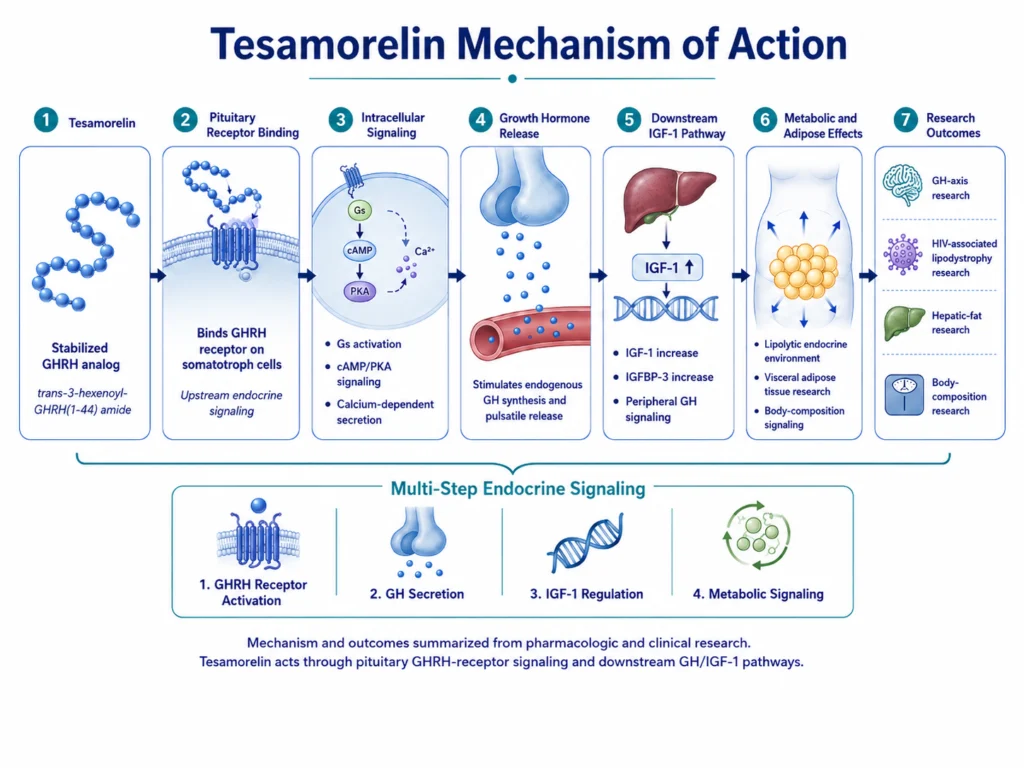
GHRH receptor activation → intracellular cAMP/PKA signaling → endogenous GH release → downstream IGF-1 and IGFBP-3 signaling
Tesamorelin is also the active ingredient in an FDA-approved prescription medication used for one specific indication: reducing excess abdominal fat in adults with HIV-associated lipodystrophy. That approval does not extend to general weight management or research-grade tesamorelin.¹
Tesamorelin Mechanism of Action: The Science Explained
Tesamorelin acts upstream of growth hormone by stimulating the body’s GH-regulatory pathway. Its mechanism can be summarized as:
- Activation of the GHRH receptor
- cAMP/PKA signaling inside pituitary somatotrophs
- Endogenous growth hormone synthesis and release
- Downstream IGF-1 and IGFBP-3 elevation
- GH-dependent signaling in peripheral tissues
- Structural stabilization through its N-terminal modification
Importantly, tesamorelin is not growth hormone. It is a signaling peptide used to study how GHRH-receptor activation influences the broader GH/IGF-1 axis.
1. GHRH Receptor Activation
Tesamorelin binds to growth hormone–releasing hormone receptors on somatotroph cells in the anterior pituitary. These are the same receptors activated by endogenous GHRH released from the hypothalamus.¹⁴
The GHRH receptor is a class B G-protein-coupled receptor. Laboratory testing reported in the prescribing information found that tesamorelin binds and stimulates human GHRH receptors with potency similar to endogenous GHRH.¹
By reproducing the receptor-level signal of natural GHRH, tesamorelin stimulates the pituitary through the body’s existing GH-release pathway rather than bypassing it with externally supplied growth hormone.
Why this matters:
GHRH-receptor activation allows researchers to study GH secretion at the level of pituitary regulation. The response still depends on a functional hypothalamic-pituitary axis and the ability of pituitary somatotroph cells to produce and release GH.
2. cAMP/PKA Signaling in Pituitary Somatotrophs
Once tesamorelin activates the GHRH receptor, the receptor interacts primarily with the stimulatory G protein known as Gs. This activates adenylate cyclase, the enzyme responsible for increasing intracellular cyclic adenosine monophosphate, or cAMP.⁴
Rising cAMP concentrations activate protein kinase A. The cAMP/PKA pathway supports several processes involved in the somatotroph response, including:
- Growth hormone gene transcription
- Growth hormone synthesis
- Electrical activity within the somatotroph
- Calcium-dependent release of stored GH
- Continued responsiveness to GHRH stimulation
The receptor can also influence additional intracellular pathways, including calcium signaling, but the cAMP/PKA pathway is considered the principal signaling route associated with pituitary GHRH-receptor activation.⁴
Why this matters:
Tesamorelin’s endocrine effects begin with receptor-level intracellular signaling. The peptide does not directly create GH or IGF-1; it initiates the cellular processes that tell pituitary somatotrophs to produce and release growth hormone.
3. Endogenous Growth Hormone Synthesis and Release
The immediate endocrine result of GHRH-receptor activation is increased synthesis and release of endogenous growth hormone from the anterior pituitary.¹
Growth hormone is naturally secreted in pulses rather than as a constant, flat signal. Its secretion is regulated by several interacting factors, including:
- Hypothalamic GHRH
- Somatostatin
- Ghrelin
- Sleep and circadian rhythms
- Age
- Nutritional and metabolic status
- Feedback from GH and IGF-1
Tesamorelin has been described as increasing both basal and pulsatile GH secretion. Pharmacokinetic and pharmacodynamic modeling also characterized its GH response as episodic—a finite period of stimulated secretion following tesamorelin exposure.²³
This differs from recombinant growth hormone, which supplies GH directly and therefore bypasses pituitary GHRH-receptor activation.
Why this matters:
By stimulating endogenous GH release, tesamorelin preserves more of the upstream regulatory structure of the GH axis than direct GH administration. The magnitude of the response can still vary according to pituitary function, age, metabolic status, and other biological factors.
4. Downstream IGF-1 and IGFBP-3 Signaling
After being released into circulation, growth hormone acts on receptors in multiple peripheral tissues, including the liver, skeletal muscle, bone, and adipose tissue.¹
One of its major downstream effects is stimulation of insulin-like growth factor 1 production. IGF-1 is produced primarily in the liver, although it can also be produced locally in peripheral tissues.
Tesamorelin-related increases in GH are followed by increased circulating IGF-1 and insulin-like growth factor binding protein 3, or IGFBP-3.¹³ IGFBP-3 is the primary binding protein responsible for transporting IGF-1 in circulation and regulating its availability to tissues.
Pharmacodynamic modeling suggests that the GH response occurs earlier, while the rise in IGF-1 develops more gradually as a downstream endocrine response.³
The pathway can therefore be viewed as a sequence:
Tesamorelin → GHRH receptor → pituitary GH release → hepatic and peripheral IGF-1 production
Why this matters:
Tesamorelin is relevant to more than GH release alone. It provides a model for studying how upstream pituitary stimulation affects the broader GH/IGF-1 axis over time.
5. GH-Dependent Signaling in Peripheral Tissues
Growth hormone released following tesamorelin stimulation can bind to GH receptors expressed by numerous cell types. The current prescribing information identifies target cells that include hepatocytes, adipocytes, myocytes, osteoblasts, and chondrocytes.¹
Through these tissues, GH participates in pathways related to:
- Lipid mobilization
- Protein metabolism
- Glucose regulation
- Tissue growth and remodeling
- Bone and cartilage biology
- Hepatic and peripheral IGF-1 production
Some GH effects are mediated through IGF-1, while others result from direct GH-receptor signaling.¹
Adipose-Tissue Signaling
Growth hormone has lipolytic properties, meaning it can support the mobilization of stored triglycerides from adipose tissue. This GH-dependent activity is considered an important part of the biological rationale for researching tesamorelin in body-composition and visceral-adipose-tissue models.
Clinical studies have shown that tesamorelin can affect visceral adipose tissue in adults with HIV-associated lipodystrophy. However, the exact biological reason that visceral fat responds differently from subcutaneous fat has not been fully established.⁷
It is therefore more accurate to say that tesamorelin stimulates a GH-dependent endocrine environment associated with changes in visceral adipose tissue—not that tesamorelin directly binds to fat cells and selectively destroys abdominal fat.
Why this matters:
Tesamorelin’s body-composition effects occur downstream of pituitary GH stimulation. The peptide’s primary target is the GHRH receptor, not an adipose-tissue receptor.
For a detailed review of the observed outcomes, see: Tesamorelin Benefits: What Research Shows.
6. N-Terminal Modification and Peptide Stability
Tesamorelin contains the complete 44-amino-acid sequence of human GHRH with a trans-3-hexenoyl group attached to its N-terminal tyrosine residue.¹
The N-terminus of native GHRH is important for receptor activation but is also vulnerable to enzymatic degradation. Tesamorelin’s structural modification was developed to improve stability while maintaining GHRH-receptor activity.
This feature distinguishes tesamorelin from unmodified human GHRH, but it should not be confused with the drug-affinity-complex modification used in CJC-1295 with DAC.
Tesamorelin does not rely on DAC-mediated albumin binding. Current prescribing information for the EGRIFTA WR formulation reports a mean elimination half-life of approximately 11 minutes following a single subcutaneous dose in healthy participants.¹
| Feature | Natural Human GHRH | Tesamorelin |
| Peptide sequence | Human GHRH 1–44 | Human GHRH 1–44 |
| N-terminal modification | None | Trans-3-hexenoyl group |
| Primary receptor | GHRH receptor | GHRH receptor |
| Main pathway | GHRHR → cAMP/PKA → GH | GHRHR → cAMP/PKA → GH |
| Downstream signaling | IGF-1 and GH-dependent pathways | IGF-1 and GH-dependent pathways |
| Stability | Rapidly degraded | Modified to improve stability |
| DAC albumin binding | No | No |
Why this matters:
The modification changes tesamorelin’s stability and pharmacokinetic behavior without changing its fundamental receptor pathway. It remains a GHRH-receptor agonist that stimulates endogenous GH release.
Tesamorelin vs. Recombinant Growth Hormone
Tesamorelin and recombinant growth hormone can both influence the GH/IGF-1 axis, but they enter that pathway at different points.
Tesamorelin acts upstream by stimulating the pituitary. Recombinant GH supplies growth hormone directly and acts on GH receptors in peripheral tissues.
| Feature | Tesamorelin | Recombinant Growth Hormone |
| Compound type | GHRH analog | Growth hormone |
| Primary target | Pituitary GHRH receptor | Peripheral GH receptor |
| Position in pathway | Upstream of GH | GH itself |
| Source of circulating GH | Endogenous pituitary release | Externally supplied GH |
| Requires functional pituitary somatotrophs | Yes | No for direct GH exposure |
| Initial intracellular pathway | GHRHR/cAMP/PKA | GH-receptor signaling |
| Downstream IGF-1 effect | Indirect, through stimulated GH | Directly downstream of administered GH |
| Relationship to GH pulses | Stimulates endogenous secretion | Bypasses endogenous release |
The cleanest way to explain the difference is that tesamorelin tells the pituitary to release GH, while recombinant growth hormone supplies GH from outside the pituitary.
Tesamorelin’s Multi-Step Endocrine Profile
Unlike compounds that act primarily through a local tissue receptor, tesamorelin works through a coordinated endocrine cascade:
- Tesamorelin binds to the GHRH receptor on pituitary somatotrophs.
- The receptor activates Gs and adenylate cyclase.
- Intracellular cAMP rises and activates protein kinase A.
- Calcium-dependent signaling supports GH secretion.
- Endogenous GH enters circulation.
- GH activates receptors in the liver and other peripheral tissues.
- IGF-1 and IGFBP-3 concentrations increase downstream.
- GH- and IGF-1-dependent metabolic pathways are altered.
This makes tesamorelin especially relevant to research involving pituitary signaling, episodic GH release, the GH/IGF-1 axis, adipose-tissue biology, and endocrine feedback regulation.
Feedback Regulation of the GH Axis
The GH axis contains several feedback mechanisms that prevent GHRH signaling from operating as a simple one-way pathway.
As GH and IGF-1 concentrations rise, they can influence the hypothalamus and pituitary through feedback processes that reduce further GH output. Somatostatin also opposes GHRH signaling by inhibiting GH release.
Because tesamorelin acts through the GHRH receptor rather than supplying GH directly, its effects occur within this broader regulatory system.
However, receptor activation can still produce substantial increases in IGF-1. Current prescribing information recommends monitoring IGF-1 during approved tesamorelin treatment because the long-term effects of persistent IGF-1 elevation are not fully known.¹
Pituitary-Hormone Specificity
Tesamorelin primarily targets the somatotropic axis. In clinical trials used to support the approved pharmaceutical product, no clinically significant changes were observed in several other pituitary hormones, including:
- Thyroid-stimulating hormone
- Luteinizing hormone
- Adrenocorticotropic hormone
- Prolactin
These findings do not mean that tesamorelin has no effects outside the GH axis. They indicate that measurable endocrine activity in the clinical studies was primarily centered on GH, IGF-1, and IGFBP-3.¹
LLimitations: What Do Studies Say?
The core mechanism of tesamorelin is supported by several types of evidence:
- In vitro receptor-binding and activation studies
- Established GHRH-receptor biology
- Human pharmacokinetic studies
- Human GH and IGF-1 pharmacodynamic measurements
- Randomized clinical studies involving HIV-associated lipodystrophy
However, several limitations are important.
First, the detailed intracellular cAMP/PKA pathway is based largely on the established biology of the human GHRH receptor. Tesamorelin-specific human studies generally measure downstream hormone concentrations rather than directly sampling intracellular signaling inside pituitary somatotrophs.
Second, clinical evidence is concentrated in adults with HIV-associated lipodystrophy. Results from this population should not automatically be generalized to healthy adults, general obesity, athletic performance, anti-aging applications, or other unapproved settings.
Third, the biological mechanisms responsible for the observed difference between visceral and subcutaneous adipose-tissue responses are not completely understood.
Finally, tesamorelin requires a functional hypothalamic-pituitary axis to produce its intended pituitary response. The FDA-approved product is contraindicated in people with disruption of that axis resulting from conditions such as pituitary surgery, pituitary tumors, head irradiation, hypopituitarism, or head trauma.¹
The clean scientific distinction is:
Well established: Tesamorelin activates the GHRH receptor, stimulates endogenous GH secretion, and increases IGF-1 and IGFBP-3.
Supported but more complex: GH-dependent signaling contributes to changes in visceral adipose tissue and other metabolic measurements.
Not fully resolved: The precise molecular explanation for tissue-specific changes in visceral versus subcutaneous fat.
Conclusion
Tesamorelin works by mimicking human growth hormone–releasing hormone and activating the GHRH receptor on anterior-pituitary somatotroph cells.
This receptor activation stimulates the Gs–adenylate cyclase–cAMP/PKA pathway, supports calcium-dependent growth hormone secretion, and increases endogenous GH release. Growth hormone then acts on receptors in the liver and other peripheral tissues, producing downstream increases in IGF-1 and IGFBP-3.
Tesamorelin does not supply growth hormone directly and does not primarily act by binding to adipose tissue. Its effects begin upstream at the pituitary and develop through a multi-step endocrine pathway involving GH, IGF-1, and tissue-specific GH-receptor signaling.
Its N-terminal hexenoyl modification improves stability compared with natural GHRH while preserving the same fundamental receptor mechanism.
FAQs About Tesamorelin’s Mechanism
How does tesamorelin stimulate growth hormone release?
Tesamorelin activates growth hormone–releasing hormone receptors on pituitary somatotroph cells. This initiates intracellular cAMP/PKA and calcium-dependent signaling that supports the synthesis and release of endogenous growth hormone.
Is tesamorelin the same as growth hormone?
No. Tesamorelin is a GHRH analog, not growth hormone. It stimulates the pituitary gland to release endogenous GH, while recombinant growth hormone supplies GH directly.
Does tesamorelin increase IGF-1?
Tesamorelin stimulates endogenous growth hormone release, and GH subsequently increases IGF-1 production in the liver and peripheral tissues. Clinical pharmacodynamic studies and prescribing information report increases in IGF-1 and IGFBP-3.
Does tesamorelin directly target visceral fat?
Tesamorelin stimulates endogenous rather than externally supplied GH. Research describes increases in basal and pulsatile GH secretion and models the response as episodic. The response still occurs within the broader regulatory environment of the hypothalamic-pituitary axis.
Does tesamorelin preserve pulsatile GH secretion?
Rodent studies have reported region-specific changes in dopaminergic and serotonergic systems. The findings do not support a simple conclusion that Semax uniformly increases dopamine or serotonin throughout the brain or reliably produces the same effects in humans.
What is the purpose of tesamorelin’s hexenoyl modification?
The trans-3-hexenoyl group attached near tesamorelin’s N-terminus was designed to improve stability compared with unmodified human GHRH while preserving GHRH-receptor activation.
Does tesamorelin work if the pituitary gland is not functioning normally?
Tesamorelin depends on functional pituitary somatotroph cells to stimulate endogenous GH release. The FDA-approved product is contraindicated in patients with disruption of the hypothalamic-pituitary axis.
Related Articles
- What Is Tesamorelin?
- Tesamorelin Benefits
- What Is CJC-1295?
- How Does CJC-1295 Work?
- What Is Sermorelin?
- How Does Sermorelin Work?
References
- U.S. National Library of Medicine. EGRIFTA WR (tesamorelin) Prescribing Information. DailyMed. Revised March 2025. https://dailymed.nlm.nih.gov/dailymed/drugInfo.cfm?setid=839334d3-8c1d-4c26-9036-2ab524a6ea75
- González-Sales M, Barrière O, Tremblay PO, Nekka F, Desrochers J. Population pharmacokinetic analysis of tesamorelin in HIV-infected patients and healthy subjects. Clinical Pharmacokinetics. 2015;54(3):303–313. https://pubmed.ncbi.nlm.nih.gov/25358450/
- González-Sales M, Barrière O, Tremblay PO, Nekka F, Desrochers J. Population pharmacokinetic and pharmacodynamic analysis of tesamorelin and its effects on growth hormone and insulin-like growth factor 1. Journal of Pharmacokinetics and Pharmacodynamics. 2015;42(3):287–299. PMID: 25895899. 2015. https://pubmed.ncbi.nlm.nih.gov/25895899/
- Zhou F, Zhang H, Cong Z, et al. Structural basis for activation of the growth hormone-releasing hormone receptor. Nature Communications. 2020;11(1):5205. https://pubmed.ncbi.nlm.nih.gov/33060564/
- Rivier J, Spiess J, Thorner MO, Vale W. Characterization of a growth hormone-releasing factor from a human pancreatic islet tumour. Nature. 1982;300(5889):276–278. https://pubmed.ncbi.nlm.nih.gov/6292724/
- Guillemin R, Brazeau P, Bohlen P, et al. Growth hormone-releasing factor from a human pancreatic tumor that caused acromegaly. Science. 1982;218(4572):585–587. https://pubmed.ncbi.nlm.nih.gov/6812220/
- Falutz J, Mamputu JC, Potvin D, et al. Effects of tesamorelin in HIV-infected patients with excess abdominal fat: pooled analysis of two multicenter, double-blind, placebo-controlled Phase 3 trials with safety-extension data. Journal of Clinical Endocrinology & Metabolism. 2010;95(9):4291–4304. https://pubmed.ncbi.nlm.nih.gov/20554713/
