

 Account
 CJC-1295 DAC vs. No DAC: What’s the Difference?
What Research Shows
Introduction
CJC-1295 is a synthetic analog of growth-hormone–releasing hormone (GHRH), studied for its ability to activate the GHRH receptor and stimulate downstream growth hormone (GH) and IGF-1 signaling.¹²
One of the most common points of confusion is the difference between CJC-1295 with DAC and CJC-1295 No DAC. Both terms are widely used in research peptide discussions, but they do not always refer to the same molecule.
This article explains the key differences between CJC-1295 DAC and No DAC, including structure, half-life, signaling pattern, research use, and safety considerations.
CJC-1295 DAC vs. No DAC: Quick Comparison
| Feature | CJC-1295 with DAC | CJC-1295 No DAC / Modified GRF (1-29) |
| Core identity | Long-acting GHRH analog | Short-acting GHRH analog |
| DAC present? | Yes | No |
| Albumin binding | Yes — covalent albumin binding | No DAC-mediated albumin binding |
| Half-life | Approximately 5.8–8.1 days in human studies² | Much shorter; closer to modified GHRH fragment behavior |
| Signaling pattern | Sustained GH/IGF-1 stimulation | Shorter, more pulsatile GHRH-like stimulation |
| Main research focus | Long-duration GH-axis activation | Short-duration GH pulse modeling |
| Key distinction | Extended duration through DAC | Faster clearance without DAC |
What Does “DAC” Mean?
DAC stands for drug affinity complex. In CJC-1295, the DAC component allows the peptide to bind covalently to circulating albumin after administration.²³
Albumin is a long-lived blood protein. By attaching to albumin, CJC-1295 remains active much longer than native GHRH or shorter GHRH analogs. This albumin-binding mechanism is the core reason CJC-1295 with DAC has a much longer half-life.
In one clinical study, CJC-1295 produced dose-dependent increases in GH for six days or more and IGF-1 increases for nine to eleven days after a single administration. The estimated half-life was 5.8–8.1 days.²
Why it matters: DAC changes the entire pharmacokinetic profile. It turns CJC-1295 from a short-acting GHRH analog into a long-acting GH-axis research compound.
What Is CJC-1295 with DAC?
CJC-1295 with DAC is the molecule most accurately referred to as CJC-1295 in the scientific literature. It is a modified GHRH(1-29) analog designed to resist enzymatic breakdown and extend duration of action through albumin binding.¹²
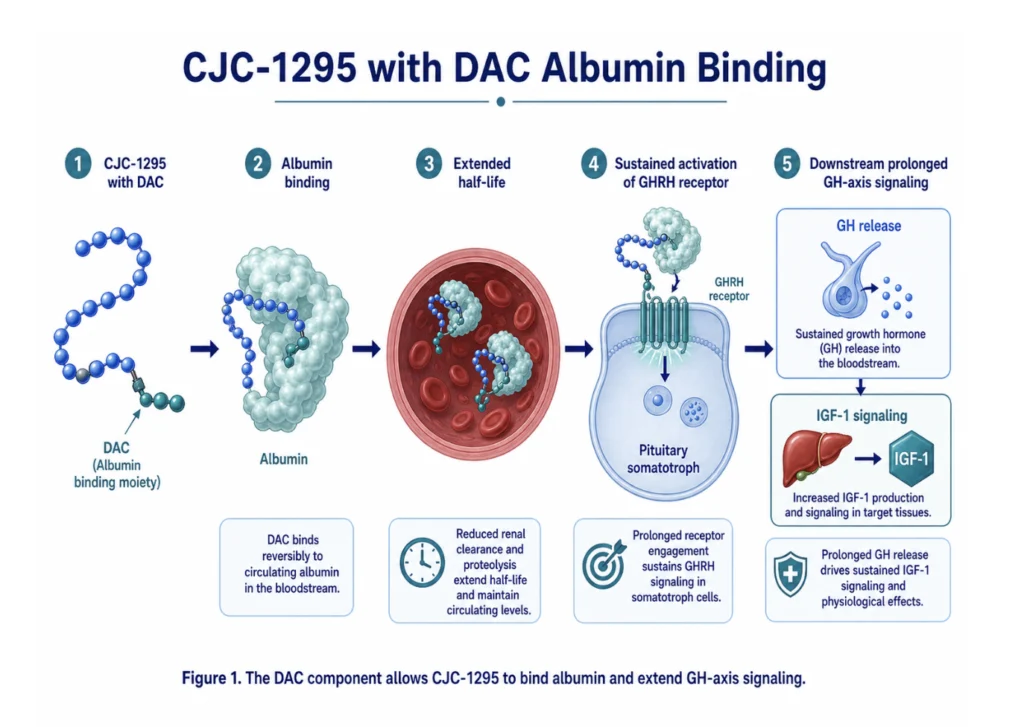
Key features of CJC-1295 DAC
CJC-1295 with DAC:
- Activates the GHRH receptor on pituitary somatotroph cells
- Stimulates endogenous GH release
- Increases downstream IGF-1 signaling
- Binds to albumin through the DAC structure
- Produces sustained GH/IGF-1 effects over multiple days²³
Because of this extended exposure, CJC-1295 DAC is usually discussed in research contexts focused on longer-duration GH-axis activation rather than short GH pulses.
What Is CJC-1295 No DAC?
“CJC-1295 No DAC” is a common market term, but it is not always chemically precise. In many contexts, it refers to Modified GRF (1-29) — a tetrasubstituted analog of the first 29 amino acids of GHRH.
Like CJC-1295 DAC, No DAC compounds are designed to activate the GHRH receptor. The major difference is that they lack the albumin-binding DAC extension.
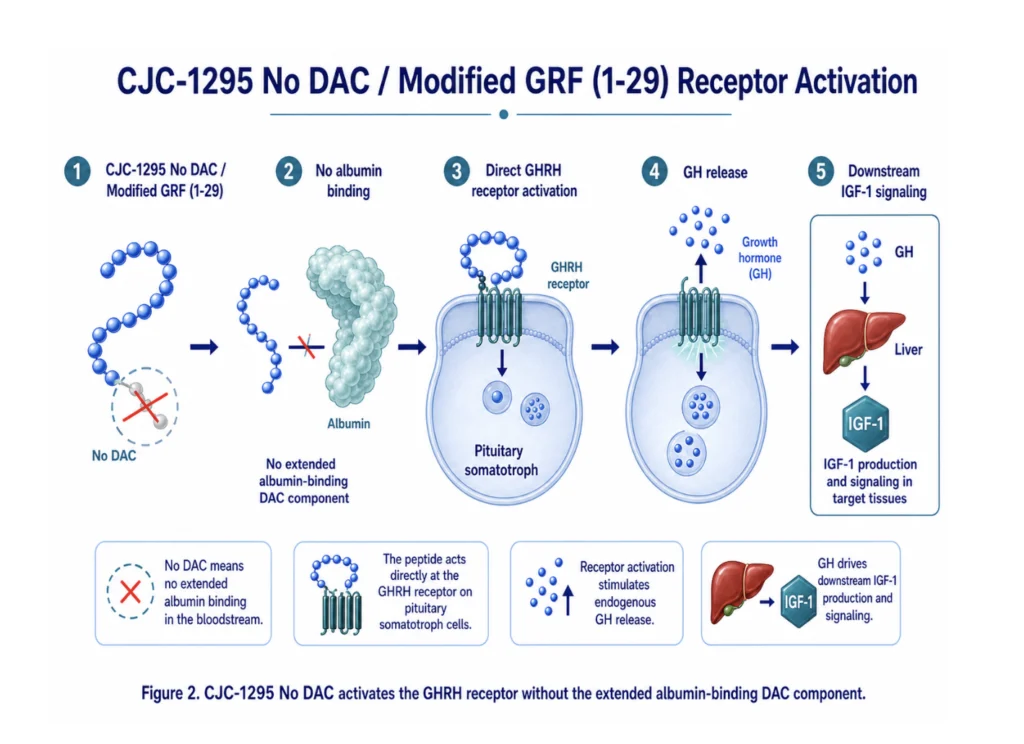
Key features of CJC-1295 No DAC
CJC-1295 No DAC / Modified GRF (1-29):
- Activates the GHRH receptor
- Stimulates GH release through endogenous pituitary signaling
- Does not use DAC-mediated albumin binding
- Has a much shorter duration of action
- Is more often discussed in research involving pulsatile GH release
Why it matters: No DAC is generally used to model shorter GHRH-like signaling, while DAC is used to study prolonged GH-axis activation.
The Main Difference: Duration of GH-Axis Signaling
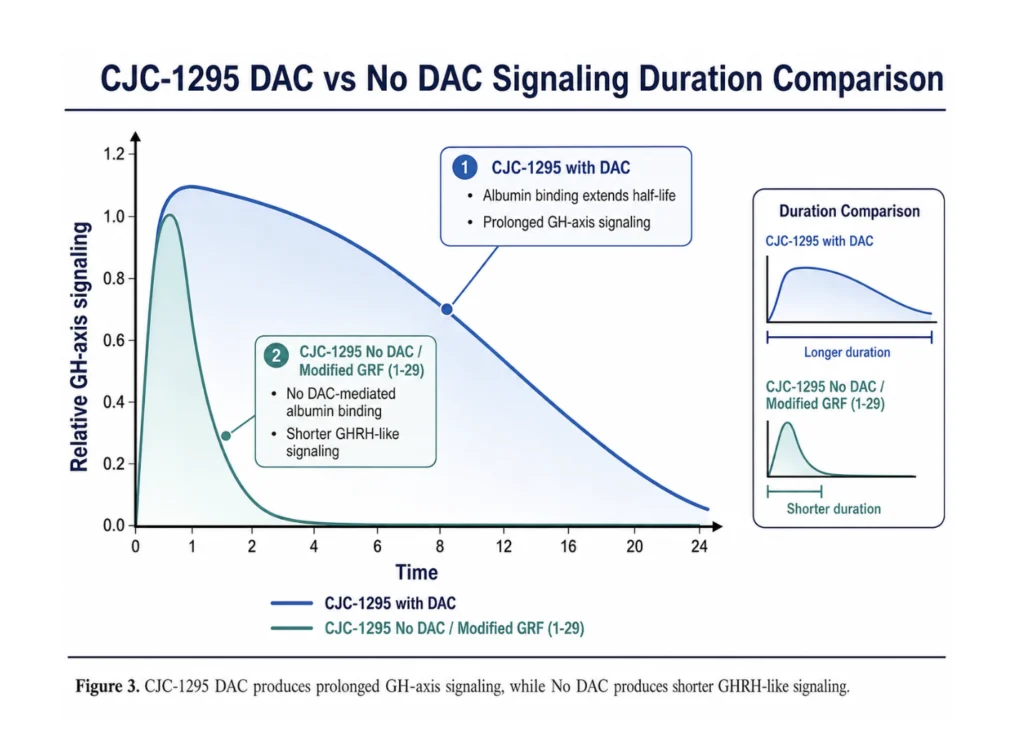
The main difference between CJC-1295 DAC and No DAC is duration.
CJC-1295 DAC is long-acting because the DAC structure allows albumin binding. This extends its half-life into the range of several days in human studies.²³
CJC-1295 No DAC lacks that albumin-binding structure. As a result, it clears much faster and is associated with shorter GH pulses rather than prolonged GH/IGF-1 elevation.
In simple terms:
- CJC-1295 DAC = longer acting
- CJC-1295 No DAC = shorter acting
- DAC changes half-life, exposure, and signaling pattern
This is why comparing the two only by name can be misleading. The presence or absence of DAC changes how the compound behaves biologically.
How Their Mechanisms Compare
Both DAC and No DAC forms act through the same primary receptor pathway:
CJC-1295 / Modified GRF → GHRH receptor → GH release → IGF-1 signaling
The difference is not the receptor target. The difference is how long the signal lasts.
CJC-1295 DAC mechanism
CJC-1295 DAC activates the GHRH receptor and remains active for a longer period because of albumin binding. This produces sustained GH/IGF-1 stimulation.²
CJC-1295 No DAC mechanism
CJC-1295 No DAC activates the same receptor pathway but without extended albumin binding. This produces a shorter signal that more closely resembles a GHRH pulse.
Research Use: When Is Each Studied?
CJC-1295 with DAC
CJC-1295 DAC is most relevant when researchers want to study:
- Prolonged GHRH receptor activation
- Sustained GH and IGF-1 elevation
- Long-duration GH-axis stimulation
- Albumin-binding peptide pharmacology
- Extended half-life peptide design
The original clinical studies focused on pharmacokinetics, pharmacodynamics, GH/IGF-1 response, and tolerability in healthy adults.²
CJC-1295 No DAC / Modified GRF (1-29)
No DAC is more relevant when researchers want to study:
- Shorter GHRH-like signaling
- Pulsatile GH release
- GH-axis responsiveness
- Interaction with GH secretagogues
- Short-acting GHRH analog behavior
This makes No DAC conceptually closer to sermorelin-style research, though it is structurally modified for greater stability than native GHRH fragments.
Safety Considerations: DAC vs No DAC
The safety considerations are similar because both act on the GH/IGF-1 axis. However, the longer duration of DAC may create different research considerations.
Potential GH/IGF-1 pathway effects
Because both compounds stimulate GH and IGF-1 signaling, researchers often monitor outcomes related to:
- Fluid retention
- Edema
- Glucose regulation
- Tissue growth signaling
- Joint discomfort or soft tissue effects
- Changes in IGF-1 levels
CJC-1295 with DAC produced sustained GH and IGF-1 elevation in clinical studies, with no serious adverse reactions reported in the published trial, though the authors noted cumulative effects after repeated dosing.²
Why DAC may require extra attention
Because DAC extends exposure, it may create a longer period of GH/IGF-1 signaling. That does not automatically make it “worse,” but it does mean the research question is different.
No DAC may be preferred in models where shorter pulses are desired. DAC may be preferred when sustained stimulation is the goal.
CJC-1295 DAC vs. No DAC: Which Is “Better”?
Scientifically, neither is automatically better. They are different tools.
CJC-1295 DAC is better suited for research into long-acting GHRH analogs and sustained GH/IGF-1 elevation.
CJC-1295 No DAC is better suited for research into shorter, pulse-like GHRH receptor activation.
The choice depends on the research model, the desired duration of action, and whether the study is focused on sustained exposure or pulsatile signaling.
Why the Naming Causes Confusion
The term “CJC-1295 No DAC” is widely used commercially, but it can be confusing because CJC-1295 in the scientific literature generally refers to the DAC-containing molecule.¹²
A more chemically precise distinction is:
- CJC-1295 with DAC: long-acting albumin-binding GHRH analog
- Modified GRF (1-29): short-acting, no-DAC GHRH analog often sold as “CJC-1295 No DAC”
For SEO and user clarity, it is still worth using the phrase “CJC-1295 No DAC,” but the article should explain the terminology clearly.
Summary
CJC-1295 DAC and CJC-1295 No DAC are both GHRH-pathway research peptides, but they differ in one crucial feature: the presence of the drug affinity complex.
CJC-1295 with DAC binds albumin and produces sustained GH/IGF-1 signaling over multiple days. CJC-1295 No DAC lacks this albumin-binding component and is associated with shorter, more pulse-like GHRH receptor activation.
For researchers, the key question is not which one is universally better. The key question is whether the model requires prolonged GH-axis stimulation or shorter-duration GHRH signaling.
FAQs About CJC-1295 DAC vs. No DAC
What is the main difference between CJC-1295 DAC and No DAC?
The main difference is half-life. CJC-1295 DAC binds albumin through its drug affinity complex, giving it a much longer duration of action. No DAC lacks this albumin-binding component and acts for a shorter period.
Is CJC-1295 No DAC the same as Modified GRF (1-29)?
In many research peptide contexts, yes. “CJC-1295 No DAC” often refers to Modified GRF (1-29), a short-acting GHRH(1-29) analog without the DAC extension.
Does CJC-1295 DAC work differently from No DAC?
Both activate the GHRH receptor and stimulate GH release. The main difference is not receptor target, but duration: DAC produces longer GH/IGF-1 signaling, while No DAC produces shorter GHRH-like signaling.
Why does DAC make CJC-1295 last longer?
DAC allows the peptide to bind covalently to albumin, a long-lived blood protein. This protects the peptide from rapid clearance and extends its half-life.
Which is better for research: DAC or No DAC?
Neither is universally better. DAC is used when sustained GH-axis stimulation is desired. No DAC is used when shorter, pulse-like GHRH signaling is preferred.
Related Articles
- What Is CJC-1295?
- How Does CJC-1295 Work?
- CJC-1295 Benefits
- CJC-1295 Side Effects & Safety
- CJC-1295 vs Ipamorelin and Other GH Secretogues
References
- Jetté L, Léger R, Thibaudeau K, Benquet C, Robitaille M, Pellerin I, Paradis V, van Wyk P, Pham K, Bridon D. Human growth hormone-releasing factor (hGRF)1-29 albumin bioconjugates activate the GRF receptor on the pituitary in rats: identification of CJC-1295 as a long-lasting GRF analog. Endocrinology. 2005;146(7):3052–3058.https://pubmed.ncbi.nlm.nih.gov/15817669/
- Teichman SL, Neale A, Lawrence B, Gagnon C, Castaigne JP, Frohman LA. Prolonged stimulation of growth hormone (GH) and insulin-like growth factor I secretion by CJC-1295, a long-acting analog of GH-releasing hormone, in healthy adults. J Clin Endocrinol Metab. 2006;91(3):799–805.https://pubmed.ncbi.nlm.nih.gov/16352683/
- Ionescu M, Frohman LA. Pulsatile secretion of growth hormone persists during continuous stimulation by CJC-1295, a long-acting growth hormone-releasing hormone analog. J Clin Endocrinol Metab. 2006;91(12):4792–4797.https://pubmed.ncbi.nlm.nih.gov/17018654/
- Sackmann-Sala L, Ding J, Frohman LA, Kopchick JJ. Activation of the GH/IGF-1 axis by CJC-1295, a long-acting GHRH analog, results in serum proteomic changes in normal adult subjects. Growth Horm IGF Res. 2009;19(6):471–477.https://pmc.ncbi.nlm.nih.gov/articles/PMC2787983/
- Alba M, Fintini D, Sagazio A, Lawrence B, Castaigne JP, Frohman LA, Salvatori R. Once-daily administration of CJC-1295, a long-acting growth hormone-releasing hormone analog, normalizes growth in growth hormone-releasing hormone knockout mice. Am J Physiol Endocrinol Metab. 2006;291(6):E1290–E1294.https://pubmed.ncbi.nlm.nih.gov/16822960/
