

 Account
 CJC-1295 vs Ipamorelin vs Sermorelin: How GH Secretagogues Compare
Disclaimer: Information provided is for research and educational purposes only. CJC-1295 is not approved by the FDA or any regulatory agency for therapeutic or cosmetic use. These compounds are not approved for human or veterinary use unless specifically noted in an approved drug context, such as tesamorelin for HIV-associated lipodystrophy.
Introduction
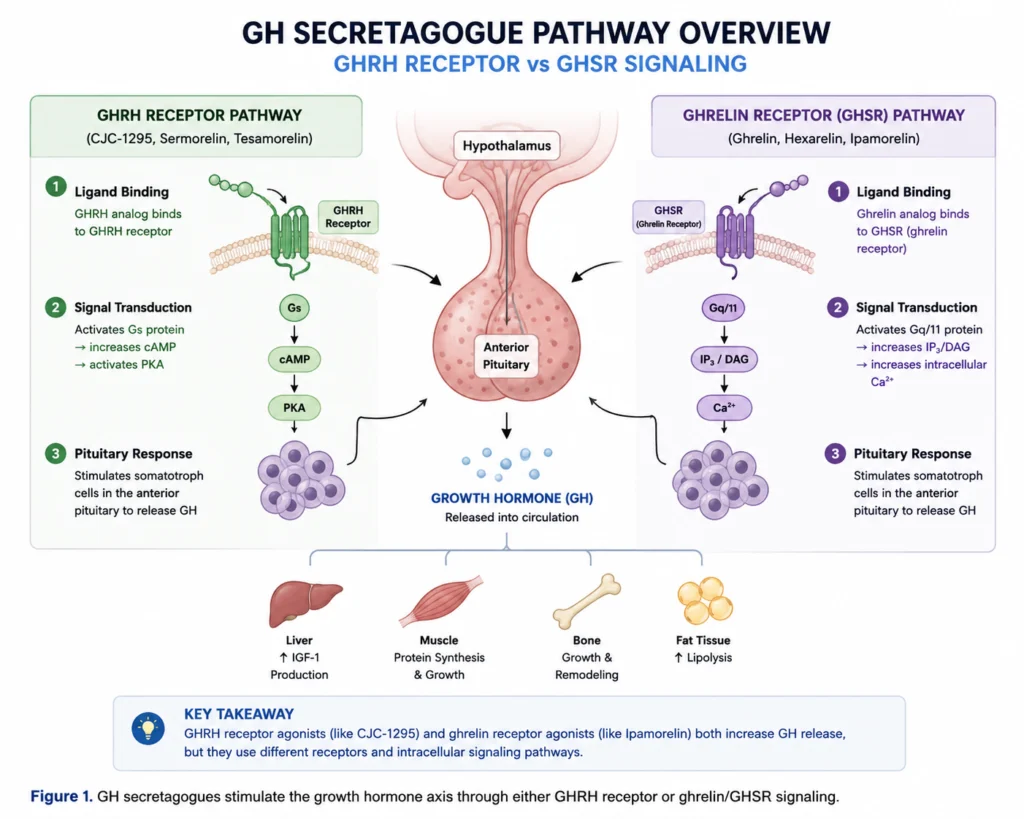
CJC-1295, Ipamorelin, and Sermorelin are often discussed together because each is studied for its relationship to the growth hormone axis. But they are not the same compound, and they do not all work through the same receptor pathway.
CJC-1295 and Sermorelin are GHRH analogs, meaning they mimic growth hormone–releasing hormone signaling at the pituitary. Ipamorelin is different: it is a growth hormone secretagogue receptor agonist, acting through the ghrelin/GHSR pathway. Other compounds in this broader research category include Tesamorelin, GHRP-2, GHRP-6, Hexarelin, and non-peptide secretagogues such as MK-677.
This article compares the major GH secretagogues by mechanism, receptor pathway, duration, research use, and how they differ from recombinant growth hormone itself.
What Are GH Secretagogues?
A growth hormone secretagogue is a compound that stimulates the body’s own growth hormone signaling rather than supplying growth hormone directly.
In research, GH secretagogues are usually grouped into two major categories:
- GHRH analogs, which activate the growth hormone–releasing hormone receptor
- Ghrelin/GHSR agonists, which activate the growth hormone secretagogue receptor
Both pathways can increase GH-axis activity, but they do so through different upstream signals. This matters because receptor pathway, duration, and downstream hormone patterns can vary significantly between compounds.
Quick Comparison: GH Secretagogues and Related Compounds
| Compound | Category | Main Pathway | Peptide? | Key Research Distinction |
| CJC-1295 with DAC | GHRH analog | GHRH receptor | Yes | Long-acting GH-axis signaling via DAC/albumin binding |
| CJC-1295 No DAC / Modified GRF (1-29 | GHRH analog | GHRH receptor | Yes | Shorter, pulse-like GHRH signaling |
| Sermorelin | GHRH analog | GHRH receptor | Yes | Classic GHRH(1-29) analog |
| Tesamorelin | GHRH analog | GHRH receptor | Yes | FDA-approved in a specific HIV-associated lipodystrophy context |
| Ipamorelin | GHRP / ghrelin mimetic | GHSR-1a | Yes | Selective GH secretagogue studied for GH release with limited ACTH/cortisol activity |
| GHRP-2 | GHRP | GHSR-1a | Yes | Potent older GH secretagogue peptide |
| GHRP-6 | GHRP | GHSR-1a | Yes | Older GHRP often associated with appetite/ghrelin-like signaling |
| Hexarelin | GHRP | GHSR-1a and related pathways | Yes | Potent GHRP with GH and cardiac research interest |
| MK-677 / Ibutamoren | Non-peptide secretagogue | GHSR-1a | No | Oral ghrelin mimetic; not a peptide |
| HGH / GH | Hormone | GH receptor | No | Not a secretagogue; bypasses upstream GH release pathways |
GHRH Analogs: CJC-1295, Sermorelin, and Tesamorelin
GHRH analogs mimic the natural hypothalamic signal that stimulates the pituitary gland to release growth hormone. Their primary receptor is the growth hormone–releasing hormone receptor, or GHRHR.
CJC-1295
CJC-1295 is a synthetic analog of GHRH. In the scientific literature, CJC-1295 generally refers to the DAC-modified, long-acting analog. The DAC component allows albumin binding, which extends its half-life and duration of GH-axis signaling. CJC-1295 with DAC produced sustained, dose-dependent increases in GH and IGF-1 in healthy-adult research, and GH pulsatility was reported to persist during continuous stimulation.¹²
In commercial research peptide contexts, the phrase CJC-1295 No DAC is also commonly used. This usually refers to Modified GRF (1-29), a shorter-acting GHRH analog without the albumin-binding DAC component.
Sermorelin
Sermorelin is a 29-amino-acid analog of human GHRH. It is often described as the shortest synthetic peptide with full biological activity of GHRH.³
Compared with CJC-1295 with DAC, Sermorelin is shorter acting and closer to the original GHRH(1-29) research framework. It is useful as a reference point because both Sermorelin and CJC-1295 act through the GHRH receptor.
Tesamorelin
Tesamorelin is another synthetic GHRH analog. It is especially important because it is one of the more clinically developed members of the GHRH analog family. FDA labeling for EGRIFTA WR states that tesamorelin is indicated for reducing excess abdominal fat in HIV-infected adults with lipodystrophy, while also noting that it is not indicated for weight-loss management and that long-term cardiovascular safety has not been established.⁴
For a research comparison article, Tesamorelin gives useful context: it shows that the GHRH analog category is not limited to CJC-1295 and Sermorelin.
Ghrelin/GHSR Agonists: Ipamorelin, GHRP-2, GHRP-6, and Hexarelin
The second major category is the growth hormone secretagogue receptor pathway, also known as GHSR-1a. This is the receptor system associated with ghrelin and many GH-releasing peptides.
Ipamorelin
Ipamorelin is a pentapeptide growth hormone secretagogue. In early research, it was described as the first selective GH secretagogue, showing GH-releasing potency while being more selective than older GHRPs in relation to ACTH and cortisol release.⁵
This is the reason Ipamorelin is often compared with, or paired with, CJC-1295. It works through a different upstream receptor system.
GHRP-2 and GHRP-6
GHRP-2 and GHRP-6 are older GH-releasing peptides that act through the growth hormone secretagogue receptor pathway. Studies have evaluated their GH-releasing effects in pituitary models and human endocrine settings.⁶
These compounds are useful for understanding the broader GHRP category, but from an SEO and commercial research standpoint, Ipamorelin tends to be the cleaner comparison point because it is more commonly paired with CJC-1295.
Hexarelin
Hexarelin is another potent GH secretagogue peptide. It has been studied for GH release and also appears in cardiac and metabolic research discussions. Some literature describes hexarelin as a peptide GH secretagogue with potent GH-stimulating activity and reported cardioprotective actions.⁷
Hexarelin belongs in a complete GH secretagogue overview, but it should not dominate the article unless keyword data supports a dedicated comparison page.
Non-Peptide GH Secretagogues: MK-677 / Ibutamoren
MK-677, also known as Ibutamoren, is an orally active non-peptide growth hormone secretagogue. It mimics ghrelin-like signaling at the GHSR pathway. Human research has found that MK-677 can enhance pulsatile GH secretion and increase fat-free mass over 12 months in older adults.⁸
MK-677 is relevant for topical completeness, but it is a different category from CJC-1295, Sermorelin, Tesamorelin, and Ipamorelin because it is not a peptide.
For Honest Peptide, I would include MK-677 as context rather than building the article around it.
CJC-1295 + Ipamorelin: Why Are They Often Studied Together?
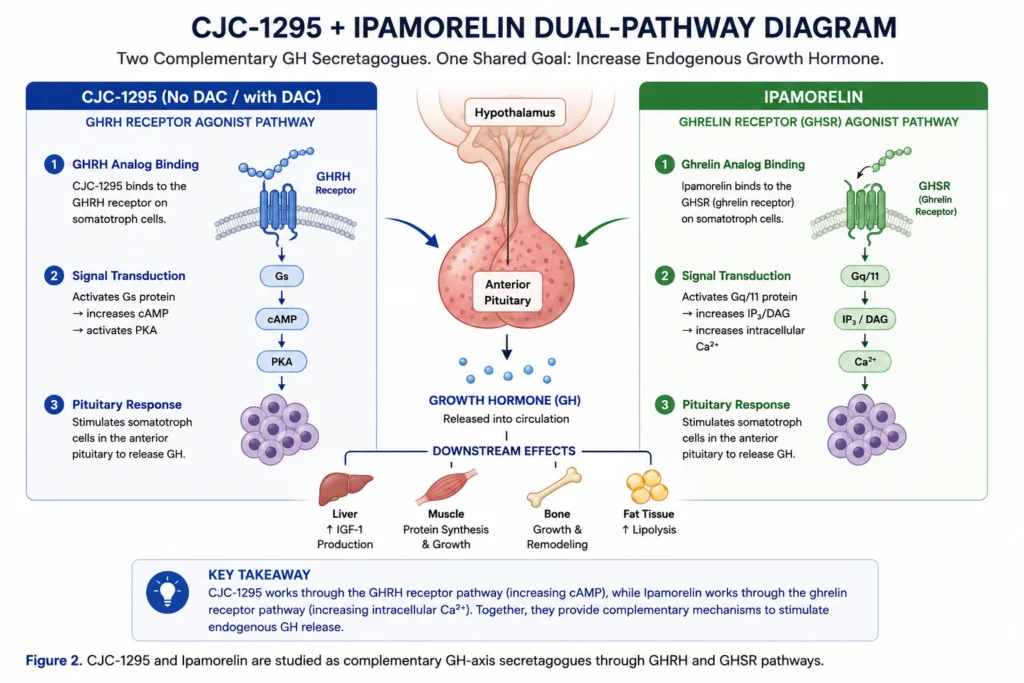
CJC-1295 and Ipamorelin are commonly discussed together because they represent two different upstream signals into the growth hormone axis.
CJC-1295: activates the GHRH receptor pathway
Ipamorelin: activates the ghrelin/GHSR pathway
In endocrine physiology, GHRH and ghrelin-like signals can act as complementary stimulators of GH release. This is why CJC-1295 and Ipamorelin are often presented as a combination in research peptide discussions.
The key point is that they are not duplicates. They are mechanistically distinct:
| Feature | CJC-1295 | Ipamorelin |
| Class | GHRH analog | GHRP / ghrelin mimetic |
| Main receptor | GHRH receptor | GHSR-1a |
| Direct target | Pituitary somatotroph GHRHR | Ghrelin/GH secretagogue receptor |
| Main research role | GHRH-like GH-axis stimulation | Ghrelin-like GH secretagogue signaling |
| Why paired? | Provides GHRH-side signal | Provides GHSR-side signal |
Why it matters:
The CJC-1295 + Ipamorelin pairing is best understood as a dual-pathway GH secretagogue research model, not simply “two peptides that do the same thing.”
CJC-1295 vs Sermorelin
CJC-1295 and Sermorelin are both GHRH analogs, so this is the closest comparison in the group.
The difference is mainly duration and modification.
Sermorelin is the simpler GHRH(1-29) analog. CJC-1295, especially the DAC-modified version, was designed to extend duration through albumin binding. CJC-1295 No DAC / Modified GRF (1-29) is closer to Sermorelin in duration but includes modifications intended to improve stability.
| Feature | Sermorelin | CJC-1295 |
| Class | GHRH analog | GHRH analog |
| Main receptor | GHRH receptor | GHRH receptor |
| Duration | Shorter acting | Depends on DAC status |
| DAC version | No | Yes |
| Research distinction | Classic GHRH(1-29) analog | Modified analog; DAC form is long acting |
Summary: Sermorelin is the cleaner classic GHRH analog. CJC-1295 is the more modified category, especially when DAC is present.
Ipamorelin vs Sermorelin
Ipamorelin and Sermorelin both stimulate the GH axis, but they do so through different receptors.
Sermorelin acts through the GHRH receptor.
Ipamorelin acts through the growth hormone secretagogue receptor / ghrelin receptor.
This makes them mechanistically distinct even though both are grouped under GH secretagogue research.
| Feature | Sermorelin | Ipamorelin |
| Category | GHRH analog | GHRP / ghrelin mimetic |
| Main receptor | GHRH receptor | GHSR-1a |
| Pathway | GHRH-like | Ghrelin-like |
| Peptide? | Yes | Yes |
| Main research distinction | Classic GHRH signaling | Selective GH secretagogue signaling |
Summary: Sermorelin and Ipamorelin are not interchangeable. They approach the GH axis from different upstream signals.
CJC-1295 vs HGH / Growth Hormone
CJC-1295, Sermorelin, Tesamorelin, and Ipamorelin are secretagogues. They stimulate upstream pathways that can increase endogenous GH signaling.
HGH, or recombinant growth hormone, is different. It is the hormone itself.
| Feature | GH Secretagogues | HGH / Recombinant GH |
| Acts upstream? | Yes | No |
| Stimulates endogenous GH release? | Yes | No |
| Directly activates GH receptor? | Indirectly through GH release | Yes |
| Preserves upstream pituitary signaling? | More relevant | Bypasses it |
| Research category | Secretagogue / releasing peptide | Hormone replacement model |
Why it matters:
Including HGH in the article helps answer common user comparisons, but it should not be the headline focus. The article is really about GH secretagogues, not direct hormone replacement.
Other GH Secretagogues: Where They Fit
A complete GH secretagogue map should include more than just CJC-1295, Ipamorelin, and Sermorelin.
GHRH analogs
These act through the GHRH receptor:
- CJC-1295 with DAC
- CJC-1295 No DAC / Modified GRF (1-29)
- Sermorelin
- Tesamorelin
- Native GHRH / GRF fragments
GHRPs and ghrelin mimetics
These act through the growth hormone secretagogue receptor pathway:
- Ipamorelin
- GHRP-2
- GHRP-6
- Hexarelin
- Alexamorelin / GHRP-1
- MK-677 / Ibutamoren, though this is non-peptide
This section is useful for SEO because it expands the article beyond a narrow three-way comparison and establishes topical authority around the broader GH secretagogue category.
Limitations: What Does the Research Say?
Direct head-to-head comparisons between CJC-1295, Sermorelin, Ipamorelin, Tesamorelin, GHRP-2, GHRP-6, Hexarelin, and MK-677 are limited.
That matters because many online comparisons treat these compounds as interchangeable. They are not.
Key limitations:
- Some compounds have direct human pharmacodynamic data.
- Others rely more heavily on animal, in vitro, or older endocrine studies.
- DAC and No DAC CJC-1295 are often confused.
- Ipamorelin data should not be generalized to all GHRPs.
- MK-677 is not a peptide and should not be treated as one.
- Tesamorelin has a specific approved-drug context that does not apply to other GH secretagogues.
For scientific accuracy, each compound should be described by its receptor pathway, evidence base, and duration profile.
Summary
CJC-1295, Ipamorelin, and Sermorelin are all connected to GH-axis research, but they differ in important ways.
CJC-1295 and Sermorelin are GHRH analogs that act through the GHRH receptor. Ipamorelin is a GHSR agonist that acts through the ghrelin receptor pathway. Tesamorelin is another GHRH analog with a specific approved-drug context, while GHRP-2, GHRP-6, Hexarelin, and MK-677 belong to the broader GH secretagogue landscape.
The most important practical distinction is pathway:
- CJC-1295 / Sermorelin / Tesamorelin: GHRH receptor pathway
- Ipamorelin / GHRP-2 / GHRP-6 / Hexarelin / MK-677: ghrelin or GHSR pathway
- HGH / GH: direct hormone, not a secretagogue
This is why CJC-1295 and Ipamorelin are often studied together: they represent complementary upstream signals into GH-axis biology.
FAQs About CJC-1295, Ipamorelin, Sermorelin, and GH Secretagogues
What is the difference between CJC-1295 and Ipamorelin?
CJC-1295 is a GHRH analog that activates the GHRH receptor. Ipamorelin is a GH secretagogue peptide that activates the ghrelin/GHSR pathway. They stimulate the GH axis through different upstream receptors.
Why are CJC-1295 and Ipamorelin often combined in research?
They are often paired because CJC-1295 provides GHRH-receptor signaling while Ipamorelin provides GHSR/ghrelin-receptor signaling. This creates a dual-pathway GH secretagogue research model.
Is Sermorelin the same as CJC-1295?
No. Both are GHRH analogs, but Sermorelin is the classic GHRH(1-29) analog, while CJC-1295 is more modified. CJC-1295 with DAC has a longer duration because of albumin binding.
Is Tesamorelin a GH secretagogue?
Yes. Tesamorelin is a GHRH analog that stimulates GH-axis signaling. It also has a specific FDA-approved indication for reducing excess abdominal fat in HIV-infected adults with lipodystrophy.
Is Ipamorelin the same as GHRP-6?
No. Both act through the ghrelin/GHSR pathway, but Ipamorelin is generally discussed as more selective, while GHRP-6 is an older GH-releasing peptide often associated with appetite-related signaling.
Is MK-677 a peptide?
No. MK-677, also known as Ibutamoren, is a non-peptide oral GH secretagogue. It acts through ghrelin-like GHSR signaling but is not a peptide.
Is HGH a GH secretagogue?
No. HGH is growth hormone itself. GH secretagogues stimulate upstream signaling that can increase endogenous GH release, while HGH directly supplies the hormone.
Related Articles
- What Is CJC-1295?
- How Does CJC-1295 Work?
- CJC-1295 Benefits
- CJC-1295 Side Effects & Safety
- CJC-1295 DAC vs No DAC
- What Is Sermorelin?
- What is Ipamorelin?
References
- Teichman SL, Neale A, Lawrence B, Gagnon C, Castaigne JP, Frohman LA. Prolonged stimulation of growth hormone and insulin-like growth factor I secretion by CJC-1295, a long-acting analog of GH-releasing hormone, in healthy adults. J Clin Endocrinol Metab. 2006;91(3):799–805. https://pubmed.ncbi.nlm.nih.gov/16352683/
- Ionescu M, Frohman LA. Pulsatile secretion of growth hormone persists during continuous stimulation by CJC-1295, a long-acting growth hormone-releasing hormone analog. J Clin Endocrinol Metab. 2006;91(12):4792–4797. https://pubmed.ncbi.nlm.nih.gov/17018654/
- Prakash A, Goa KL. Sermorelin: a review of its use in the diagnosis and treatment of children with idiopathic growth hormone deficiency. BioDrugs. 1999;12(6):419–436. https://pubmed.ncbi.nlm.nih.gov/18031173/
- U.S. Food and Drug Administration. EGRIFTA WR prescribing information. 2025. https://www.accessdata.fda.gov/drugsatfda_docs/label/2025/022505s020lbl.pdf
- Raun K, Hansen BS, Johansen NL, et al. Ipamorelin, the first selective growth hormone secretagogue. Eur J Endocrinol. 1998;139(5):552–561. https://pubmed.ncbi.nlm.nih.gov/9849822/
- Wu D, Chen C, Katoh K, Zhang J, Clarke IJ. The effects of GH-releasing peptide-6 and GHRP-2 on GH release. J Endocrinol. 1996. https://pubmed.ncbi.nlm.nih.gov/8699133/
- Brywe KG, Leverin AL, Gustavsson M, et al. Growth hormone-releasing peptide hexarelin reduces neonatal brain injury and promotes GH secretion. Endocrinology. 2005. https://pubmed.ncbi.nlm.nih.gov/16081643/
- Nass R, Pezzoli SS, Oliveri MC, et al. Effects of an oral ghrelin mimetic on body composition and clinical outcomes in healthy older adults. Ann Intern Med. 2008;149(9):601–611. https://pubmed.ncbi.nlm.nih.gov/18981485/
- Sackmann-Sala L, Ding J, Frohman LA, Kopchick JJ. Activation of the GH/IGF-1 axis by CJC-1295, a long-acting GHRH analog, results in serum proteomic changes in normal
