Account
Introduction
Cagrilintide is a synthetic, long-acting analogue of amylin, a hormone normally released from pancreatic beta cells alongside insulin. Its development focuses on appetite regulation and weight management.1
The molecule contains 37 amino-acid residues and a lipid modification that helps extend its activity. It activates amylin receptors and the calcitonin receptor in experimental systems, placing it in a different receptor class from GLP-1 medicines such as semaglutide.1,2
Cagrilintide has been studied alone and together with semaglutide. The combination is known as CagriSema. Results from the combination should be distinguished from results with cagrilintide alone.3,4
Cagrilintide Fast Facts
| Property | Details |
|---|---|
| Compound name | Cagrilintide |
| Development name | AM833 |
| Class | Long-acting, lipidated amylin analogue |
| Peptide length | 37 amino-acid residues |
| Structural features | Cys2–Cys7 disulfide bridge, C-terminal amide, and N-terminal lipid modification |
| Lipid component | C20 fatty diacid connected through a γ-glutamyl linker |
| Molecular formula | C₁₉₄H₃₁₂N₅₄O₅₉S₂, without counterions |
| Molecular weight | Approximately 4409.1 g/mol |
| Structure identifier | PubChem CID 171397054 |
| Receptor activity | Amylin receptor and calcitonin receptor agonism |
| Main research areas | Appetite, food intake, weight management, receptor signaling, and combination therapy.1,2,5 |
Chemical Structure
Cagrilintide was developed from the amylin-analogue backbone used in pramlintide. Amino-acid substitutions and lipidation were introduced to support a stable, long-acting molecule.1
Its peptide chain includes a disulfide bond joining the cysteines at positions 2 and 7. The final residue is amidated. At the other end, a γ-glutamyl linker connects a C20 fatty diacid to the peptide's N-terminus.2,5
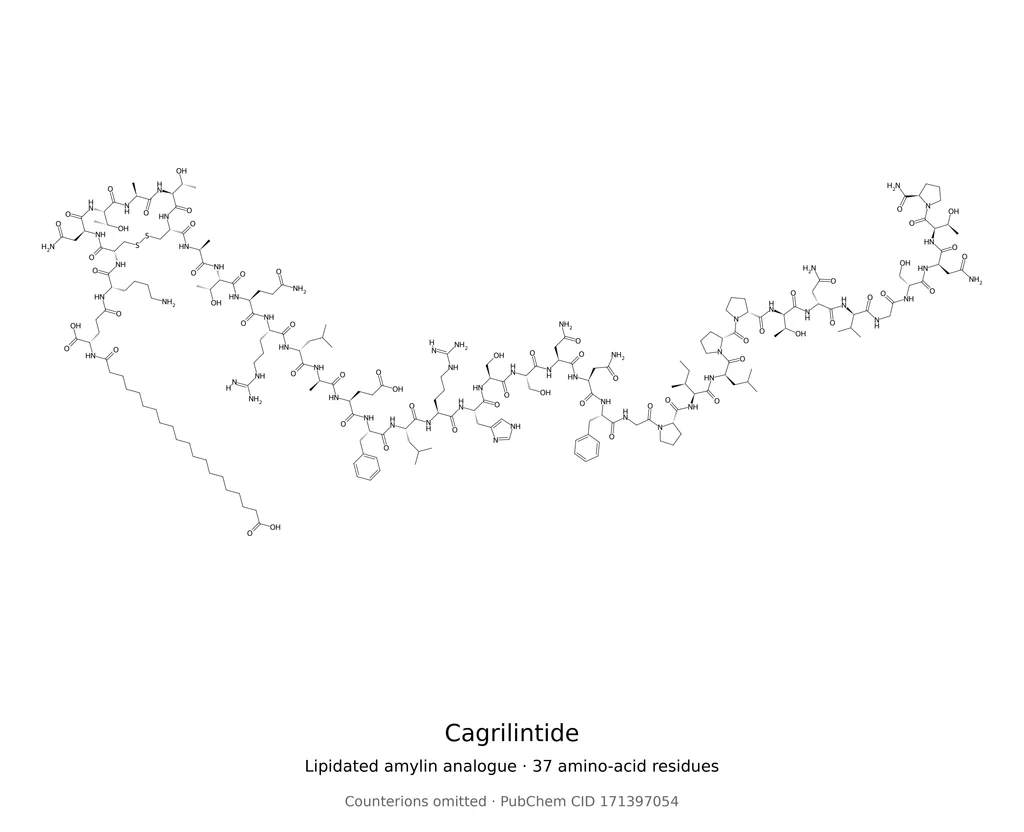
The formula describes the reference molecule itself. A salt, solution, or finished formulation contains additional components that require separate identification.
How Cagrilintide Works (In Brief)
Amylin helps communicate that food has been consumed. Cagrilintide engages receptors associated with this signaling system, supporting research into reduced food intake and body weight.1,6
Amylin receptors consist of the calcitonin receptor paired with one of three receptor activity-modifying proteins, called RAMPs. Cagrilintide can activate these complexes and the calcitonin receptor without a RAMP in laboratory systems.2
Animal experiments implicate hindbrain circuits involved in feeding. Human trials establish weight outcomes, but they do not determine the contribution of every receptor subtype or brain-cell population to those outcomes.4,6,7
For a more detailed explanation, see: How Does Cagrilintide Work?
Discovery & Research Milestones
2021
Kruse et al.
Described cagrilintide's molecular development and long-acting design.1
2021
Lau et al.
Reported weight reduction in a 26-week, randomized phase 2 monotherapy trial.3
2021
Enebo et al.
Evaluated coadministration with semaglutide and measured prolonged exposure.8
2025
Cao et al.
Resolved cagrilintide-bound amylin and calcitonin receptor structures.2
2025
Garvey et al.
Reported phase 3 REDEFINE 1 results for combination and individual components.4
2026
Ludwig et al.
Investigated hindbrain cell populations and causal feeding mechanisms in rats.7
What Research Shows
Human Monotherapy Research
The 2021 phase 2 study randomized 706 adults across five cagrilintide groups, a liraglutide group, and placebo. Participants had overweight or obesity and did not have diabetes.3
At 26 weeks, estimated mean weight reductions across cagrilintide groups ranged from 6.0% to 10.8%, compared with 3.0% for placebo. These figures used the trial-product estimand, which estimates an effect assuming treatment adherence.3
The findings support a weight-management effect under the trial conditions. They do not establish the same response for every person or for products obtained outside the clinical development program.
Combination Research
REDEFINE 1 randomized 3,417 adults without diabetes to CagriSema, semaglutide alone, cagrilintide alone, or placebo, with lifestyle intervention in every group. At 68 weeks, estimated mean weight reduction was 20.4% with the combination versus 3.0% with placebo, using the treatment-policy estimand.4
That estimate accounts for treatment discontinuation within the trial's analysis framework. It is a CagriSema result and should not be described as the weight loss produced by cagrilintide alone.
Receptor and Brain Research
Structural studies directly show how cagrilintide engages experimentally prepared amylin and calcitonin receptor complexes. Mouse studies support a role for AMY1 and AMY3 receptor systems in its feeding and weight effects.2,6
A 2026 study combined cross-species brainstem mapping with experiments in rats. Reducing expression of prolactin-releasing hormone, Prlh, in the dorsal vagal complex prevented cagrilintide's effects in that rat model. This is mechanistic animal evidence rather than proof that the identical intervention explains human trial outcomes.7
Cagrilintide vs Semaglutide
| Feature | Cagrilintide | Semaglutide |
|---|---|---|
| Hormone system | Amylin analogue | GLP-1 analogue |
| Receptor pharmacology | Amylin and calcitonin receptors | GLP-1 receptor |
| Combination name | Together, the two form CagriSema | Together, the two form CagriSema |
| Evidence interpretation | Requires its own monotherapy results | Cannot represent the entire combination's effect |
Different receptor targets provide a rationale for combining the two molecules. The clinical effect of that combination must still be measured directly rather than calculated by adding results from unrelated trials.4,8
Safety and Regulatory Interpretation
Gastrointestinal adverse events, including nausea, constipation, and diarrhea, were common in the phase 2 trial. Injection-site reactions were also reported. In REDEFINE 1, gastrointestinal events were common with CagriSema and were mostly transient and mild to moderate.3,4
These findings describe monitored clinical trials. They do not establish the safety of research-grade material, unsupervised use, or every possible treatment combination.
As of November 18, 2026, cagrilintide remains investigational. The sponsor's November 14 update also describes CagriSema as investigational and not approved in the United States. Approval of semaglutide products does not confer approval on cagrilintide or the combination.9
Summary
Cagrilintide is a lipidated, 37-residue amylin analogue designed for prolonged activity. Its receptor pharmacology includes amylin and calcitonin receptor activation, and its clinical development focuses on weight management.
Human trials support weight reduction under studied conditions. Receptor and animal studies help explain possible mechanisms, while individual human brain pathways and the separate contributions within CagriSema require careful interpretation.