


 Account
What Is Kisspeptin?
The KISS1-Derived Peptide Family Used to Study Reproductive Hormone Signaling
Disclaimer: Information provided is for research and educational purposes only. Kisspeptin peptides and experimental kisspeptin-receptor agonists are being investigated in clinical and laboratory studies. No kisspeptin peptide has an FDA-approved therapeutic indication in the United States.17,18 Research-grade materials are not approved for human or veterinary use. Regulatory status may differ internationally.
Introduction
Kisspeptin is the name for a family of related peptides produced from the human KISS1 gene. The best studied forms are kisspeptin-54 (KP-54, formerly called metastin) and the shorter kisspeptin-10 (KP-10). Both activate the kisspeptin receptor, KISS1R, previously called GPR54.1,7
In the brain, kisspeptin signaling helps regulate neurons that release gonadotropin-releasing hormone (GnRH). GnRH then stimulates the pituitary gland to release luteinizing hormone (LH) and follicle-stimulating hormone (FSH). This places kisspeptin upstream of several key signals involved in puberty and reproductive function.3,4,5
The KISS1 gene was first identified in research on melanoma metastasis. Its role in reproductive biology became clear when researchers connected kisspeptin with GPR54 and found that loss of receptor function disrupted puberty in humans and mice.3,4,6
Note: “Kisspeptin” does not identify one unique peptide length. When evaluating a study or a research material, the specific form—such as KP-54 or KP-10—matters. Findings for one form, dose, or experimental setting should not automatically be applied to another.
Kisspeptin Fast Facts
| Property | Details |
| Class | Endogenous reproductive neuropeptides; RF-amide peptide family |
| Development Name | KISS1 |
| Precursor | 145-amino-acid KISS1 protein in humans |
| Common Active Forms | Kisspeptin-54, -14, -13, and -10 |
| Primary Target | Kisspeptin receptor KISS1R (formerly GPR54) |
| Main Pathway | KISS1R activation → GnRH signaling → pituitary LH and FSH release |
| Main Research Uses | Puberty and reproductive-axis biology, gonadotropin secretion, hypothalamic amenorrhea, and oocyte maturation in IVF research |
| Structural Feature | Shared amidated C-terminal sequence important for KISS1R activation |
| Alternative Name | Metastin refers specifically to kisspeptin-54 |
| FDA-Approved Context | None for kisspeptin peptides17,18 |
| Not the same as GnRH | Kisspeptin generally acts upstream of GnRH neurons rather than replacing GnRH directly |
Chemical Structure
The human KISS1 gene encodes a 145-amino-acid precursor that is processed into shorter biologically active peptides. KP-54 contains 54 amino acids and is C-terminally amidated. KP-14, KP-13, and KP-10 share its C-terminal region; the final 10 amino acids are sufficient to activate KISS1R in receptor assays.1,7
KP-10 and KP-54 therefore belong to the same signaling family, but they are not interchangeable research materials. KP-10 can activate KISS1R in vitro, while differences in degradation and clearance can change responses after administration in living systems.7,8 A molecular weight or chemical diagram would need to specify the peptide form and any salt or counterion.
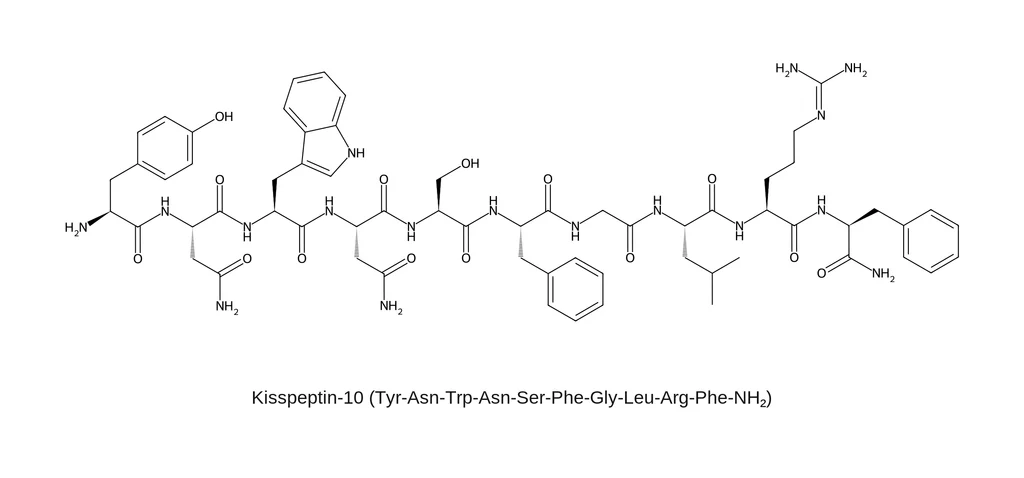
In simple terms, KISS1 makes a larger precursor that is cut into kisspeptin forms of different lengths. These forms retain a shared receptor-activating end of the molecule.
How Kisspeptin Works (In Brief)
Kisspeptin binds to KISS1R, a G-protein-coupled receptor. In the reproductive axis, kisspeptin signaling stimulates GnRH neurons in the hypothalamus. GnRH reaches the pituitary, which releases LH and FSH; those gonadotropins subsequently act on the gonads.4,5
The key point is that kisspeptin is not LH, FSH, or GnRH. It operates earlier in the signaling sequence. Receptor and animal studies support a direct action on many GnRH neurons, while human administration studies show subsequent changes in circulating reproductive hormones.5,9,10
Responses depend on the peptide form, timing, hormonal state, and administration pattern. For example, repeated KP-54 administration in women with hypothalamic amenorrhea produced a weaker response over time in one small study, while other schedules have been investigated separately.11
For a more detailed explanation of receptor signaling and downstream pathways, see: How Does Kisspeptin Work?
Discovery & Research Milestones
Kisspeptin research began in cancer biology. The subsequent identification of its receptor and the genetics of puberty redirected much of the field toward neuroendocrinology. More recent human trials have examined hormone responses and potential applications in assisted reproduction.
| Year | Study or Event | Key Finding |
| 1996 | Lee JH et al., Journal of the National Cancer Institute | Identified KiSS-1 in experiments on the metastatic potential of melanoma cells.6 |
| 2001 | Kotani M et al., Journal of Biological Chemistry | Identified KISS1-derived kisspeptins as natural ligands for the previously orphan receptor GPR54.1 |
| 2003 | de Roux N et al., PNAS; Seminara SB et al., New England Journal of Medicine | Linked loss-of-function GPR54 mutations to hypogonadotropic hypogonadism and impaired pubertal development.3,4 |
| 2005 | Messager S et al., PNAS | Demonstrated kisspeptin-dependent stimulation of GnRH release in experimental models.5 |
| 2005 | Dhillo WS et al., JCEM | Reported increased LH, FSH, and testosterone during KP-54 infusion in healthy men.9 |
| 2009 | Jayasena CN et al., JCEM | Found acute gonadotropin responses to KP-54 in women with hypothalamic amenorrhea, with diminished responses during frequent repeated administration.11 |
| 2011 | George JT et al., JCEM | Showed that KP-10 stimulated LH secretion in men; an infusion protocol also increased LH pulse measures and testosterone.10 |
| 2014 | Jayasena CN et al., JCEM | Reported increased LH pulsatility during KP-54 infusion in a small study of women with hypothalamic amenorrhea.12 |
| 2014 | Jayasena CN et al., Journal of Clinical Investigation | Studied KP-54 as an experimental trigger of oocyte maturation in 53 women undergoing IVF.13 |
| 2015–2017 | Abbara A et al., JCEM and Human Reproduction | Further investigated KP-54 oocyte-maturation protocols in women at high risk of ovarian hyperstimulation syndrome.14,15 |
What Research Shows
Puberty and Reproductive-Axis Signaling
The strongest evidence that KISS1R signaling is important to normal reproductive development comes from human genetics and supporting animal experiments. Inactivating GPR54/KISS1R mutations were linked to hypogonadotropic hypogonadism, a condition characterized by insufficient gonadotropin signaling and absent or incomplete pubertal development.3,4
Experimental studies then showed that kisspeptin can stimulate GnRH release through KISS1R.5 This helps explain why a signal initially studied in cancer biology became central to research on the hypothalamic-pituitary-gonadal axis.
Hormone Responses in Humans
Small controlled human studies have shown that administered kisspeptin can increase reproductive-hormone secretion under studied conditions. KP-54 infusion increased LH and FSH in healthy men, while KP-10 studies documented rapid LH responses and changes in LH pulsatility.9,10
In women, the response varies with menstrual-cycle phase and underlying hormonal state. Investigators have studied KP-54 in healthy participants and in women with hypothalamic amenorrhea, including its effects on LH pulses.12,16 These physiological responses do not by themselves establish a treatment for infertility or hormone deficiency.
Oocyte-Maturation Research
Researchers have investigated KP-54 as a way to trigger the body’s own LH surge during some IVF protocols. An initial study in 53 women reported mature oocytes after KP-54 administration.13 Later Phase 2 studies investigated women at high risk of ovarian hyperstimulation syndrome and examined whether a second KP-54 dose improved oocyte yield.14,15
These were supervised clinical studies within specific IVF protocols. They do not establish that kisspeptin improves fertility in the general population, and KP-54 is not an FDA-approved IVF medication.
Metastasis-Related Research
The name KISS1 originated in experiments involving suppression of metastatic behavior in melanoma models.6 This is an important part of the peptide family’s discovery, but cell and animal findings do not show that administering a kisspeptin peptide prevents or treats human cancer. Cancer-related research should be interpreted separately from the human reproductive-hormone studies.
Kisspeptin-54 vs. Kisspeptin-10
KP-54 and KP-10 are related KISS1-derived peptides with a shared C-terminal receptor-activating region. Both have been used in human reproductive-hormone research, but study results must be attributed to the form that was actually tested.1,9,10
| Feature | Kisspeptin-54 | Kisspeptin-10 |
| Peptide length | 54 amino acids | 10 amino acids |
| Relationship | Longer processed KISS1 peptide; also called metastin | Short C-terminal sequence shared with longer kisspeptins |
| Primary receptor | KISS1R | KISS1R |
| Receptor activity | Activates KISS1R | Retains KISS1R-activating activity in vitro |
| Human research examples | Hormone studies; hypothalamic amenorrhea; IVF oocyte-maturation studies | Hormone and LH-pulsatility studies, including studies in men |
| Practical research distinction | Longer peptide with its own pharmacokinetic profile | Shorter form whose in-vivo behavior may differ from KP-54 |
| FDA-approved use | None | None |
The most useful distinction is that “kisspeptin” is a family name. A KP-54 IVF finding should not be presented as a demonstrated KP-10 IVF finding.8,13
Kisspeptin vs. GnRH
Kisspeptin and GnRH act at different points in the reproductive hormone pathway. Kisspeptin activates KISS1R and helps stimulate hypothalamic GnRH neurons. GnRH then acts on pituitary GnRH receptors to prompt LH and FSH secretion.4,5
Feature Kisspeptin GnRH Compound type Family of KISS1-derived peptides Gonadotropin-releasing hormone Primary receptor KISS1R on responsive cells, including GnRH neurons GnRH receptor on pituitary gonadotrophs Position in main pathway Upstream of GnRH release Upstream of pituitary LH and FSH release Direct pituitary replacement Does not supply GnRH directly Supplies the GnRH signal when administered Main research distinction Regulation of GnRH neurons and reproductive signaling Direct regulation of pituitary gonadotropin release This upstream position makes kisspeptin useful for studying how the brain controls reproductive hormone release. It does not mean that kisspeptin and GnRH have identical effects in every clinical or experimental setting.
Regulatory Status
FDA-approved ingredient: No FDA-approved kisspeptin peptide drug.17,18
Approved indication: None for kisspeptin peptides in the United States.17,18
Clinical research: KP-54, KP-10, and investigational KISS1R agonists have been studied in human research, including reproductive-hormone and IVF studies.
Research-grade distinction: A laboratory peptide labeled “kisspeptin” is not a regulated, FDA-approved prescription medication and should not be represented as approved for human or veterinary use.
Important marketing distinction: Human clinical research, including an IVF study, does not itself grant approval for a commercial kisspeptin product or establish safety and effectiveness for self-administration.
FDA has separately flagged potential immunogenicity, peptide impurities, and limited safety information for proposed uses of compounded KP-10. These concerns relate specifically to its evaluation of compounded KP-10 and should not be treated as a clinical safety profile for every kisspeptin form.17
Summary
Kisspeptin refers to a family of KISS1-derived peptides, including KP-54 and KP-10, that activate the receptor KISS1R. The human KISS1 precursor is processed into peptides of different lengths that share a receptor-activating C-terminal region.1,7
Kisspeptin is a key research subject in reproductive endocrinology because it helps stimulate hypothalamic GnRH signaling and downstream LH and FSH release. Human genetic findings, experimental models, and controlled administration studies support its importance in the reproductive axis.3,4,5,9,10
Clinical researchers have also examined KP-54 in hypothalamic amenorrhea and as an experimental oocyte-maturation trigger in IVF.12,13,14,15 Those findings apply to specific study populations and protocols. Kisspeptin peptides do not have an FDA-approved therapeutic indication.17,18
Scientifically, kisspeptin is notable for connecting a gene discovered in metastasis research with the neural control of puberty and reproductive-hormone secretion.
FAQs About Kisspeptin
What is Kisspeptin?
Kisspeptin is a family of peptide signals made from the KISS1 gene. Its members include KP-54, KP-14, KP-13, and KP-10, which share a receptor-activating C-terminal sequence.
Is Kisspeptin-10 the same as Kisspeptin-54?
No. They are different-length members of the same peptide family. Both can activate KISS1R, but they can behave differently after administration and have not been studied in identical clinical settings.
Why is Kisspeptin-54 called metastin?
Metastin is an earlier name for KP-54 that reflects the discovery of KISS1 in metastasis-suppression research. The name does not establish a cancer treatment.
What is Kisspeptin used for in research?
Researchers use kisspeptin forms to investigate KISS1R signaling, GnRH and gonadotropin release, puberty, hypothalamic amenorrhea, and experimental IVF oocyte-maturation protocols. The specific peptide and study setting matter.
How does Kisspeptin work?
Kisspeptin activates KISS1R. In its best characterized reproductive role, this stimulates GnRH-neuron signaling, followed by pituitary LH and FSH release.
Does Kisspeptin increase LH and FSH?
Human studies have reported increases in LH and, in some settings, FSH after administered KP-54 or KP-10. The response depends on factors including peptide form, hormonal state, and administration schedule.
Does kisspeptin increase testosterone?
Some controlled studies in men reported increased testosterone following kisspeptin administration alongside changes in LH signaling. These short research protocols do not establish kisspeptin as an approved treatment for low testosterone.9,10
Is Kisspeptin involved in puberty?
Yes. Human KISS1R loss-of-function mutations and supporting animal studies show that intact kisspeptin-receptor signaling is important for normal pubertal development.3,4
Has Kisspeptin been studied in IVF?
Yes. Investigators have studied KP-54 as an experimental trigger for oocyte maturation in supervised IVF protocols, including studies involving women at high risk of ovarian hyperstimulation syndrome.13,14,15
Does Kisspeptin treat infertility?
An established general infertility treatment has not been demonstrated. IVF studies of KP-54 examined a specific step in particular treatment protocols; results should not be generalized to all causes of infertility or to other kisspeptin forms.
Is Kisspeptin FDA-approved?
No kisspeptin peptide has an FDA-approved therapeutic indication in the United States.17,18 A research-grade peptide is not an FDA-approved prescription drug.
Related Articles
References
- Kotani M, Detheux M, Vandenbogaerde A, et al. The metastasis suppressor gene KiSS-1 encodes kisspeptins, the natural ligands of the orphan G protein-coupled receptor GPR54. J Biol Chem. 2001;276:34631–34636. PubMed.
- Funes S, Hedrick JA, Vassileva G, et al. The KiSS-1 receptor GPR54 is essential for the development of the murine reproductive system. Biochem Biophys Res Commun. 2003;312:1357–1363. PubMed.
- de Roux N, Genin E, Carel JC, Matsuda F, Chaussain JL, Milgrom E. Hypogonadotropic hypogonadism due to loss of function of the KiSS1-derived peptide receptor GPR54. Proc Natl Acad Sci USA. 2003;100:10972–10976. PubMed.
- Seminara SB, Messager S, Chatzidaki EE, et al. The GPR54 gene as a regulator of puberty. N Engl J Med. 2003;349:1614–1627. PubMed.
- Messager S, Chatzidaki EE, Ma D, et al. Kisspeptin directly stimulates gonadotropin-releasing hormone release via G protein-coupled receptor 54. Proc Natl Acad Sci USA. 2005;102:1761–1766. PubMed.
- Lee JH, Miele ME, Hicks DJ, et al. KiSS-1, a novel human malignant melanoma metastasis-suppressor gene. J Natl Cancer Inst. 1996;88:1731–1737. PubMed.
- Harihar S, Pounds KM, Iwakuma T, Seidah NG, Welch DR. Furin is the major proprotein convertase required for KISS1-to-kisspeptin processing. PLoS ONE. 2014;9:e84958. Full text.
- Curtis AE, Cooke JH, Baxter JE, et al. A kisspeptin-10 analog with greater in vivo bioactivity than kisspeptin-10. Am J Physiol Endocrinol Metab. 2010;298:E296–E303. PubMed.
- Dhillo WS, Chaudhri OB, Patterson M, et al. Kisspeptin-54 stimulates the hypothalamic-pituitary gonadal axis in human males. J Clin Endocrinol Metab. 2005;90:6609–6615. PubMed.
- George JT, Veldhuis JD, Roseweir AK, et al. Kisspeptin-10 is a potent stimulator of LH and increases pulse frequency in men. J Clin Endocrinol Metab. 2011;96:E1228–E1236. PubMed.
- Jayasena CN, Nijher GMK, Chaudhri OB, et al. Subcutaneous injection of kisspeptin-54 acutely stimulates gonadotropin secretion in women with hypothalamic amenorrhea, but chronic administration causes tachyphylaxis. J Clin Endocrinol Metab. 2009;94:4315–4323. PubMed.
- Jayasena CN, Abbara A, Veldhuis JD, et al. Increasing LH pulsatility in women with hypothalamic amenorrhoea using intravenous infusion of kisspeptin-54. J Clin Endocrinol Metab. 2014;99:E953–E961. PubMed.
- Jayasena CN, Abbara A, Comninos AN, et al. Kisspeptin-54 triggers egg maturation in women undergoing in vitro fertilization. J Clin Invest. 2014;124:3667–3677. PubMed.
- Abbara A, Jayasena CN, Christopoulos G, et al. Efficacy of kisspeptin-54 to trigger oocyte maturation in women at high risk of ovarian hyperstimulation syndrome during in vitro fertilization therapy. J Clin Endocrinol Metab. 2015;100:3322–3331. PubMed.
- Abbara A, Clarke S, Islam R, et al. A second dose of kisspeptin-54 improves oocyte maturation in women at high risk of ovarian hyperstimulation syndrome: a Phase 2 randomized controlled trial. Hum Reprod. 2017;32:1915–1924. PubMed.
- Dhillo WS, Chaudhri OB, Thompson EL, et al. Kisspeptin-54 stimulates gonadotropin release most potently during the preovulatory phase of the menstrual cycle in women. J Clin Endocrinol Metab. 2007;92:3958–3966. PubMed.
- U.S. Food and Drug Administration. Certain Bulk Drug Substances for Use in Compounding that May Present Significant Safety Risks. Kisspeptin-10 entry. FDA.
- U.S. Food and Drug Administration. Pharmacy Compounding Advisory Committee briefing document: Kisspeptin-10 evaluation. October 29, 2024. FDA PDF.
