Account
Introduction
Selank is a synthetic peptide made from seven amino acids. Its sequence is Thr-Lys-Pro-Arg-Pro-Gly-Pro, often abbreviated TKPRPGP. It was developed from tuftsin, a naturally occurring four-amino-acid peptide, by adding a Pro-Gly-Pro segment to the end of the molecule.¹,²
Researchers have investigated Selank for possible effects on anxiety-related behavior, neurotransmission, and learning. Its published evidence includes laboratory experiments, animal studies, and small human studies. This makes it a subject of neuropeptide research, while leaving important questions about clinical effectiveness and safety unresolved.²,³,⁴
Selank was developed by researchers in Russia and is often described in the literature as an anxiolytic peptide. “Anxiolytic” means anxiety-reducing; the term describes the activity being investigated and does not establish that a research product is a proven anxiety treatment.²

Note
Selank and Semax are different peptides. Their similar names and shared Pro-Gly-Pro ending do not make their biological effects or evidence interchangeable.
Selank Fast Facts
| Property | Details |
|---|---|
| Class | Synthetic heptapeptide; tuftsin analog |
| Other name | TP-7 |
| Amino-acid sequence | Thr-Lys-Pro-Arg-Pro-Gly-Pro (TKPRPGP) |
| Peptide length | Seven amino acids |
| Molecular formula | C33H57N11O9 (free peptide) |
| Molecular weight | Approximately 751.9 g/mol (free peptide) |
| Parent peptide | Tuftsin, Thr-Lys-Pro-Arg |
| Main research areas | Anxiety-related behavior, GABA-associated neurotransmission, learning, and stress responses |
| Evidence base | Cell and animal experiments, with limited human clinical and imaging studies |
| FDA-approved use | None identified |
| Important limitation | Experimental findings and small clinical reports do not establish broad clinical efficacy or long-term safety |
Chemical Structure
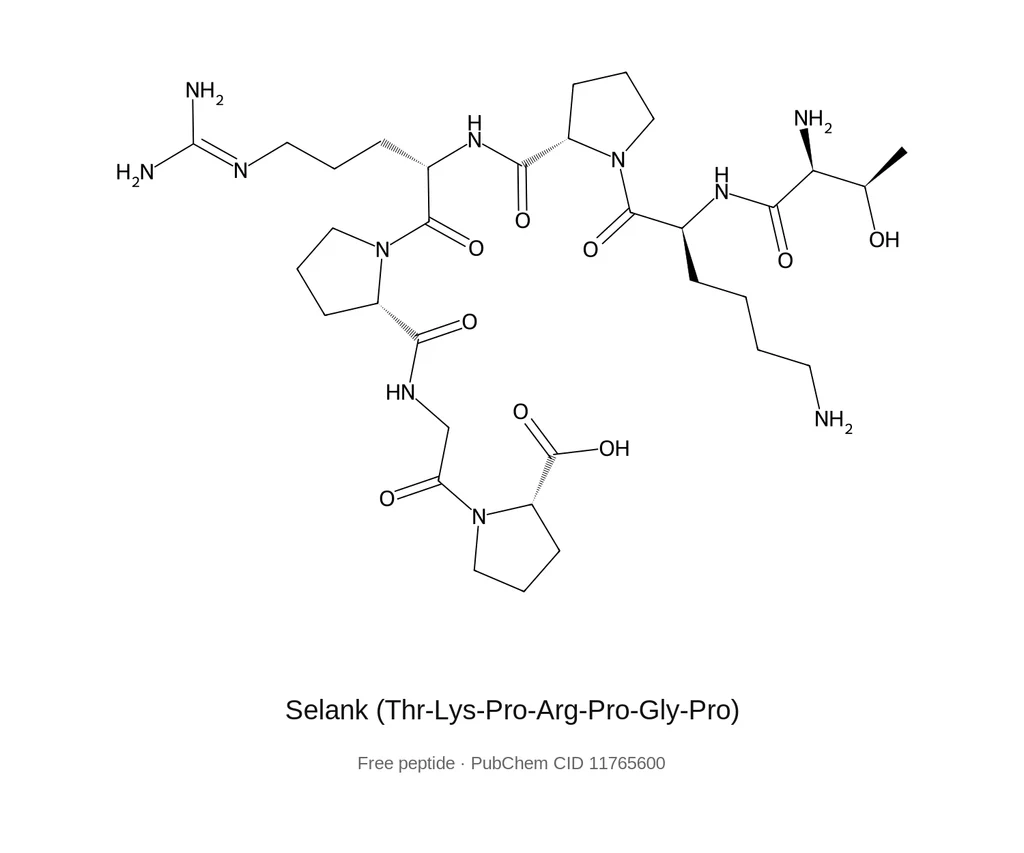
Selank is a linear peptide with the sequence Thr-Lys-Pro-Arg-Pro-Gly-Pro. The first four residues correspond to tuftsin, a fragment of the human immunoglobulin G heavy chain. The additional Pro-Gly-Pro sequence was incorporated to improve metabolic stability compared with the parent peptide.¹,²
The free peptide has a molecular formula of C33H57N11O9 and a molecular weight of approximately 751.9 g/mol. These values describe the peptide itself. Acetate and other salt preparations include counterions, which can change the molecular formula and labeled mass of the material.¹
How Selank Works (In Brief)
Selank's proposed mechanisms involve several biological systems. Research has examined changes in genes associated with GABAergic neurotransmission, meaning signaling involving gamma-aminobutyric acid, a major inhibitory neurotransmitter. Other work has investigated the breakdown of enkephalins, naturally occurring signaling peptides.²,⁵
These findings support continued study of how Selank may affect neural signaling. They do not establish one complete clinical pathway or prove that Selank acts as a benzodiazepine-like GABA receptor drug. In a human-derived cell line, Selank alone did not significantly change the measured neurotransmission-related genes, although combinations with other compounds changed the response.⁶
For a more detailed explanation of the experimental pathways, see: How Does Selank Work?
Discovery & Research Milestones
Selank's research history includes biochemical studies, clinical comparisons, and experiments examining gene expression and brain-network activity. The timeline below summarizes selected publications rather than regulatory milestones.
2001
Zozulya et al., Bulletin of Experimental Biology and Medicine
Selank inhibited enkephalin breakdown in a laboratory assay, suggesting a possible mechanism for further investigation.⁵
2008
Zozulia et al., Zhurnal Nevrologii i Psikhiatrii
A study of 62 patients compared Selank with medazepam and reported similar anxiety-related improvements.³
2015
Medvedev et al., Zhurnal Nevrologii i Psikhiatrii
A 70-patient study compared phenazepam alone with phenazepam plus Selank and reported differences in clinical response and tolerability.⁴
2016
Volkova et al., Frontiers in Pharmacology
Rat frontal-cortex experiments found changes in genes associated with GABAergic and other neurotransmission pathways.²
2017
Filatova et al., Frontiers in Pharmacology
A human neuroblastoma-cell experiment found that responses depended on whether Selank was tested alone or with other compounds.⁶
2019
Kolik et al., Bulletin of Experimental Biology and Medicine
A rat study examined memory performance and BDNF content in a model involving prolonged ethanol exposure.⁷
2020
Panikratova et al., Doklady Biological Sciences
A study involving 52 healthy participants across Selank, Semax, and placebo groups examined resting-state functional connectivity.⁸
What Research Shows
Anxiety-Related Clinical Research
A 2008 study included 62 patients with generalized anxiety disorder or neurasthenia, a diagnosis involving fatigue and related symptoms. Thirty received Selank and 32 received medazepam. The authors reported similar anxiolytic effects, along with additional differences in fatigue-related and activating effects.³
This is a preliminary comparative finding. Similar outcomes in a small study do not establish formal equivalence to medazepam or show that Selank can replace established treatments.
A 2015 study compared phenazepam alone in 30 patients with phenazepam plus Selank in 40 patients. The authors reported an earlier response on one rating scale and fewer reported adverse effects in the combination group. Because Selank was added to another medication, the results concern that combination rather than Selank alone.⁴
Neurotransmission and Gene Expression
In rats, Selank administration changed the expression of genes associated with neurotransmission in the frontal cortex. Some early changes resembled those observed after GABA administration, providing a basis for further work on GABA-associated mechanisms.²
A subsequent experiment used IMR-32 cells, a human neuroblastoma cell line. Selank alone did not significantly alter the studied gene-expression measures. Responses differed when it was combined with GABA or olanzapine. This variation shows that the experimental context matters; a human-derived cell line is also different from a clinical study in people.⁶
Learning and Neurotrophin Research
A 2019 rat experiment examined recognition memory after prolonged ethanol exposure. Selank-treated animals showed changes in selected behavioral outcomes and in brain-derived neurotrophic factor, or BDNF, measurements.⁷
The BDNF result is sometimes oversimplified. In this model, Selank prevented the ethanol-associated increase in BDNF content in the studied brain regions. It should not be described as evidence that Selank always raises BDNF. The experiment also does not establish a treatment for alcohol-related disorders or memory loss in people.⁷
Human Brain-Imaging Research
A 2020 study examined resting-state functional connectivity in 52 healthy participants assigned across Selank, Semax, and placebo groups. The researchers reported differences in connectivity involving the right amygdala and temporal brain regions.⁸
Functional connectivity describes statistical relationships between brain-imaging signals. A change in connectivity is an experimental observation; it does not by itself demonstrate anxiety relief, improved attention, or better memory.
Safety and Evidence Gaps
The published human studies provide information about short-term observations in specific settings. They do not establish comprehensive long-term safety, dependence risk, interactions, or a safe regimen for different populations and formulations.³,⁴
The FDA specifically notes that compounded Selank acetate may pose immunogenicity concerns for certain routes because of aggregation and peptide-related impurities. The agency also states that it lacks important human safety information. These concerns relate to the evaluated substance and preparations; they are not a quantified rate of adverse reactions for every Selank product.⁹
Selank vs. Tuftsin
Tuftsin is the naturally occurring four-residue peptide Thr-Lys-Pro-Arg. Selank contains that sequence followed by Pro-Gly-Pro, making it a distinct seven-residue molecule.²
| Feature | Selank | Tuftsin |
|---|---|---|
| Sequence | Thr-Lys-Pro-Arg-Pro-Gly-Pro | Thr-Lys-Pro-Arg |
| Length | Seven amino acids | Four amino acids |
| Origin | Synthetic analog | Naturally occurring immunoglobulin-derived peptide |
| Pro-Gly-Pro extension | Present | Absent |
| Relationship | Built from the tuftsin sequence | Parent sequence used to develop Selank |
A shared sequence provides a structural relationship. It does not mean that every immune or neurological finding for tuftsin also applies to Selank, or that Selank has a demonstrated “immune-boosting” effect in people.
Selank vs. Semax
Selank and Semax are both synthetic seven-amino-acid peptides with a Pro-Gly-Pro ending. Their first four residues differ: Selank begins with the tuftsin sequence, while Semax begins with the Met-Glu-His-Phe sequence corresponding to ACTH residues 4–7.¹,²,¹⁰
| Feature | Selank | Semax |
|---|---|---|
| Sequence | Thr-Lys-Pro-Arg-Pro-Gly-Pro | Met-Glu-His-Phe-Pro-Gly-Pro |
| Abbreviation | TKPRPGP | MEHFPGP |
| Starting sequence | Tuftsin-derived | ACTH-fragment-derived |
| Shared ending | Pro-Gly-Pro | Pro-Gly-Pro |
| Same molecule? | No | No |
| Interchangeable study results? | No | No |
Neither the shared ending nor the similar names establish that combining the peptides is more effective or safer. The cited imaging study examined them as separate interventions.⁸
Regulatory Status
FDA-approved medication: No FDA-approved Selank medication was identified in the resources reviewed.⁹,¹¹
Approved U.S. indication: None established.
Research status: Selank has a published preclinical literature and limited human studies, principally from Russian research settings.
Safety-related FDA assessment: The agency identifies concerns and missing human safety information for compounded Selank acetate.⁹
Important distinction: A substance identifier, research listing, or compounding nomination does not confer FDA drug approval.
Summary
Selank is the synthetic heptapeptide Thr-Lys-Pro-Arg-Pro-Gly-Pro, abbreviated TKPRPGP. It was developed by extending the natural tuftsin sequence with Pro-Gly-Pro.¹,²
Its research profile includes anxiety-related clinical comparisons, neurotransmission experiments, animal learning studies, and human brain imaging. These findings support further investigation while leaving uncertainty about the mechanism, reproducibility of clinical effects, and long-term safety.3,4,6,7,8
Selank is chemically distinct from both tuftsin and Semax. Understanding those differences, and the limitations of each study model, is essential when interpreting claims about the peptide.