


CJC-1295 Side Effects & Safety
What Research Shows
Introduction
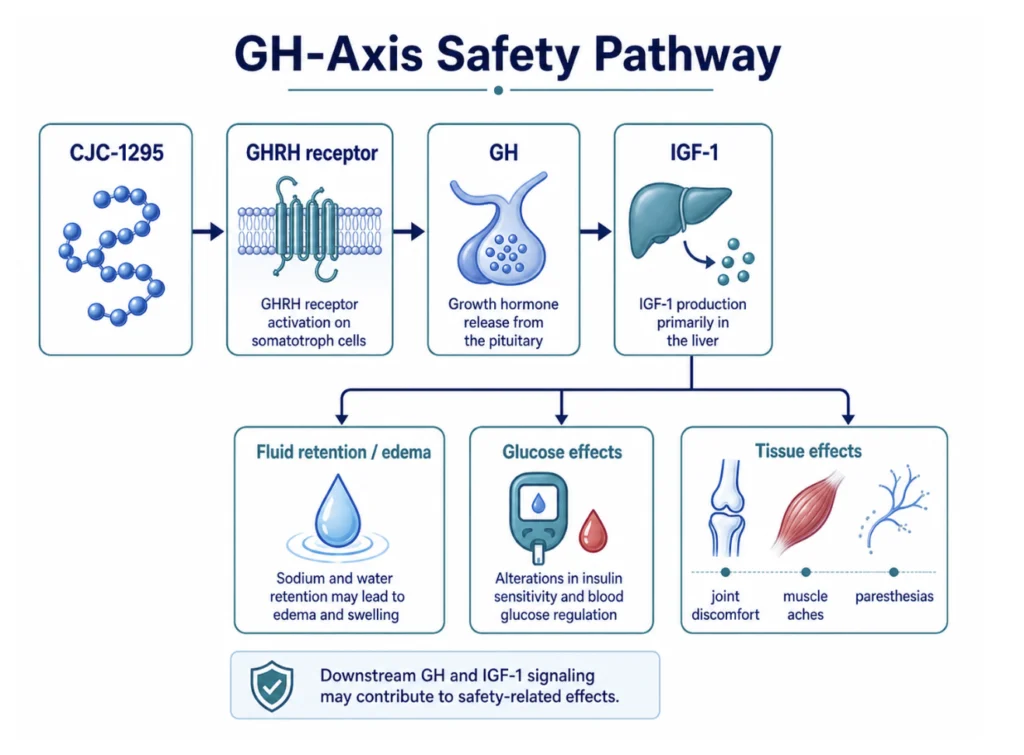
CJC-1295 is a synthetic analog of growth hormone–releasing hormone (GHRH), studied for its ability to activate the GHRH receptor, stimulate endogenous growth hormone release, and support downstream IGF-1 signaling.
Because CJC-1295 acts upstream of growth hormone, its safety profile is tied to two overlapping issues:
- Peptide-specific effects, such as injection-site reactions or transient flushing
- GH/IGF-1-axis effects, such as fluid retention, joint discomfort, changes in glucose handling, or other effects associated with elevated growth hormone signaling
The safety discussion is also complicated by naming. CJC-1295 with DAC is the long-acting, albumin-binding form with the strongest direct human study data. CJC-1295 without DAC, often called Modified GRF (1-29), is shorter acting and relies more heavily on broader GHRH analog and sermorelin-adjacent evidence.
This article reviews what research shows about CJC-1295 side effects, safety concerns, regulatory cautions, and the key difference between DAC and No DAC forms.
Summary Table: CJC-1295 Side Effects & Safety Data
| Reported / Potential Effect | Evidence Level | Most Relevant Form | Notes | |
| Injection-site reactions | Moderate | Mostly DAC human studies | Transient pain, swelling, and induration were among the most frequently reported events | |
| Flushing / vasodilatory reaction | Moderate | GHRH analog class / FDA safety review | FDA has flagged systemic vasodilatory reactions among safety concerns for CJC-1295 | |
| Increased heart rate | Regulatory concern | CJC-1295 category | FDA has identified serious adverse events including increased heart rate | |
| Headache / lightheadedness | Plausible / class-related | GHRH analog class | Fluid retention / edema | Reported with some GHRH analogs; not always CJC-specific |
Fluid retention / edema | ||||
| Fluid retention / edema | Theoretical / GH-axis related | More relevant with sustained GH/IGF-1 elevation | Common concern in GH replacement literature | |
| Joint or muscle discomfort | Theoretical / GH-axis related | More relevant with elevated GH signaling | Seen with GH therapy and GH excess states | |
| Carpal-tunnel-like symptoms / paresthesia | Theoretical / GH-axis related | Sustained GH/IGF-1 exposure | Known downstream GH-related safety endpoint | |
| Glucose-handling changes | Theoretical / GH-axis related | Sustained GH/IGF-1 exposure | Relevant because GH affects insulin sensitivity and metabolic signaling | |
| Immunogenicity / impurities | Regulatory concern | Compounded or non-pharma sources | FDA notes immunogenicity and peptide impurity concerns | |
| Long-term safety | Limited data | Both DAC and No DAC | Long-term controlled human data are insufficient |
1. Injection-Site Reactions
The most clearly reported short-term side effects in CJC-1295 research are local injection-site reactions.
In a healthy-adult study of CJC-1295 with DAC, the most frequently reported adverse events were injection-site reactions, including transient pain, swelling, and induration. The same study reported no serious adverse reactions and found sustained, dose-dependent increases in GH and IGF-1 after subcutaneous administration.
Potential local reactions include:
- Redness
- Mild swelling
- Tenderness
- Itching
- Temporary discomfort
- Local firmness or induration
Why it matters:
Injection-site reactions appear to be the most concrete short-term adverse event signal in published CJC-1295 clinical research, especially for the DAC-modified form.
2. Flushing, Vasodilation, and Increased Heart Rate
GHRH analogs can produce transient systemic effects, including flushing or vasodilatory symptoms. This is especially important because the FDA has identified serious adverse events associated with CJC-1295, including increased heart rate and systemic vasodilatory reaction. The FDA also notes that available clinical data are limited.
Potential short-term systemic effects may include:
- Facial flushing
- Warmth or vasodilatory sensation
- Lightheadedness
- Increased heart rate
- Temporary discomfort
Why it matters:
These effects are not just theoretical. They have been highlighted in regulatory safety review, so they should be included clearly in any CJC-1295 safety article.
3. GH/IGF-1-Axis Related Effects
CJC-1295 stimulates the GH/IGF-1 axis rather than acting as growth hormone itself. That distinction matters, but it does not eliminate downstream GH-related safety considerations.
Human research on CJC-1295 with DAC showed sustained increases in GH and IGF-1. A related study found that CJC-1295 increased trough and mean GH secretion and IGF-1 production while preserving GH pulsatility.
Because GH and IGF-1 signaling can influence fluid balance, connective tissue, metabolism, and glucose regulation, potential GH-axis-related effects include:
- Water retention
- Peripheral edema
- Joint stiffness or discomfort
- Muscle aches
- Paresthesias or tingling
- Carpal-tunnel-like symptoms
- Changes in insulin sensitivity or glucose handling
Adult GH replacement literature consistently identifies fluid-retention-related effects — including edema, arthralgia, carpal tunnel syndrome, and paresthesias — as common side effects of GH treatment.
Why it matters:
CJC-1295 is not GH, but it is designed to increase GH-axis activity. Any safety discussion should therefore include downstream GH/IGF-1 effects as relevant endpoints.
4. DAC vs No DAC: Why Safety Profiles May Differ
The biggest safety distinction within the CJC-1295 category is duration of exposure.
CJC-1295 with DAC includes a drug-affinity-complex modification that binds albumin and extends activity. In healthy adults, DAC-modified CJC-1295 produced dose-dependent GH increases for six days or more and IGF-1 increases for nine to eleven days after a single injection; after multiple doses, mean IGF-1 remained above baseline for up to 28 days.
CJC-1295 No DAC, commonly called Modified GRF (1-29), lacks the albumin-binding extension and is shorter acting. It is more relevant to transient GHRH receptor activation rather than prolonged GH/IGF-1 exposure.
| Feature | CJC-1295 with DAC | CJC-1295 No DAC / Modified GRF (1-29) |
| DAC extension | Yes | No |
| Albumin binding | Yes | No DAC-mediated binding |
| Duration | Long-acting | Shorter-acting |
| Main safety issue | Sustained GH/IGF-1 exposure | Limited direct human safety data |
| Strongest evidence | Human clinical studies | GHRH analog / Modified GRF / sermorelin literature |
| Regulatory concern | FDA has flagged CJC-1295 category safety concerns | Still affected by naming and sourcing ambiguity |
Why it matters:
It is not scientifically clean to copy the safety profile of DAC-modified CJC-1295 onto No DAC / Modified GRF (1-29). They share the same core receptor pathway, but their exposure profiles are different.
5. Immunogenicity, Impurities, and Product-Quality Risks
CJC-1295 safety is not only about the peptide’s intended biological mechanism. Product quality matters.
The FDA has flagged CJC-1295-related concerns including possible immunogenicity for certain routes of administration, peptide-related impurities, and API characterization complexity.
Quality-related risks may include:
- Incorrect peptide identity
- Peptide impurities
- Endotoxin contamination
- Poor sterile handling
- Inaccurate concentration
- Degradation from improper storage
- Counterfeit or mislabeled products
Why it matters:
For research peptides, safety risk can come from bad material as much as from the peptide’s intended mechanism. Third-party identity, purity, endotoxin, and contaminant testing are central to responsible research sourcing.
6. Long-Term Safety Unknowns
The available human CJC-1295 studies are limited and mostly involve the DAC-modified form. The best-known studies were short-term endocrine studies in healthy adults, measuring GH, IGF-1, pharmacokinetics, and tolerability.
Key unknowns include:
- Long-term effects of repeated GH-axis stimulation
- Effects of sustained IGF-1 elevation
- Effects on glucose metabolism and insulin sensitivity
- Cardiovascular effects in higher-risk populations
- Immunogenicity after repeated exposure
- Differences between DAC and No DAC safety profiles
- Safety of non-pharmaceutical or poorly characterized peptide sources
Why it matters:
Short-term tolerability does not equal long-term safety. This is especially true for a peptide that modulates the GH/IGF-1 axis.
Safety Profile in Research
1. No Serious Adverse Reactions in Short-Term DAC Studies
In the major healthy-adult study of CJC-1295 with DAC, no serious adverse reactions were reported. The study also found sustained, dose-dependent GH and IGF-1 increases.
This is reassuring but limited: the study was short-term and focused on healthy adults.
2. GH Pulsatility Was Preserved in DAC Research
A related CJC-1295 DAC study found that GH secretion remained pulsatile despite continuous stimulation, while trough and mean GH secretion and IGF-1 production increased.
This matters mechanistically because pulsatility is a key feature of physiologic GH signaling.
3. FDA Has Flagged CJC-1295 Safety Concerns
The FDA has identified serious adverse events associated with CJC-1295, including increased heart rate and systemic vasodilatory reaction, and has highlighted concerns about immunogenicity, peptide-related impurities, and limited clinical data.
This should be stated plainly in any safety article.
4. GH-Axis Side Effects Are Biologically Plausible
Because CJC-1295 is designed to increase GH-axis signaling, GH-related effects such as fluid retention, edema, joint discomfort, paresthesias, and carpal-tunnel-like symptoms are relevant safety endpoints, even when not proven specifically for every form of CJC-1295.
DAC and No DAC Are Often Confused
Searches for “CJC-1295 side effects” often mix DAC and No DAC evidence. A good safety article should clarify which form is being discussed.
Regulatory Concerns Exist
The FDA has flagged CJC-1295 for safety concerns in the compounding context, including serious adverse events and quality-control concerns.
Research Use Only
CJC-1295 is not approved for human or veterinary use and should be framed as a laboratory research peptide only.
Summary
CJC-1295’s safety profile is best understood in layers:
- Published DAC studies: injection-site reactions were common; no serious adverse reactions were reported in short-term healthy-adult research.
- Regulatory safety review: FDA has identified serious adverse events including increased heart rate and systemic vasodilatory reaction, and has flagged concerns around immunogenicity, impurities, and limited data.
- GH-axis biology: because CJC-1295 increases GH/IGF-1 signaling, fluid retention, edema, joint discomfort, paresthesias, carpal-tunnel-like symptoms, and glucose-handling changes are relevant theoretical or downstream safety endpoints.
- No DAC uncertainty: CJC-1295 No DAC / Modified GRF (1-29) is shorter acting, but direct long-term human safety evidence remains limited.
The responsible conclusion is conservative: CJC-1295 has short-term human tolerability data for the DAC form, but long-term safety remains insufficiently characterized, and regulatory agencies have raised meaningful safety and quality-control concerns..
FAQs About CJC-1295 Side Effects
What are the most common side effects of CJC-1295?
The most clearly reported side effects in published CJC-1295 DAC research are injection-site reactions, including transient pain, swelling, and induration. Other potential effects include flushing, increased heart rate, headache, lightheadedness, and GH-axis-related effects such as fluid retention or joint discomfort.
Is CJC-1295 safe?
Short-term studies of CJC-1295 with DAC reported no serious adverse reactions, but the data are limited. The FDA has identified serious adverse events associated with CJC-1295 and has raised concerns about immunogenicity, impurities, and limited clinical data.
What is the difference between CJC-1295 with DAC and No DAC for safety?
CJC-1295 with DAC is long-acting because it binds albumin and has the strongest direct human data. CJC-1295 No DAC / Modified GRF (1-29) is shorter acting, but has less direct human safety evidence. They should not be treated as identical.
Can CJC-1295 cause water retention?
Water retention is a known downstream concern with elevated GH signaling. It is not equally characterized for every form of CJC-1295, but it is a relevant safety endpoint in GH-axis research.
Does CJC-1295 increase heart rate?
The FDA has identified serious adverse events associated with CJC-1295, including increased heart rate and systemic vasodilatory reaction. This should be considered a meaningful safety concern.
Is CJC-1295 approved for human use?
No. CJC-1295 is not approved for human or veterinary use and should be described as a laboratory research peptide only.
Related Articles
- What Is CJC-1295?
- How does CJC-1295 Work?
- CJC-1295 Benefits
- CJC-1295 DAC vs No DAC
- CJC-1295 vs Ipamorelin and Other GH Secretogues
References
- Teichman SL, Neale A, Lawrence B, Gagnon C, Castaigne JP, Frohman LA. Prolonged stimulation of growth hormone and insulin-like growth factor I secretion by CJC-1295, a long-acting analog of GH-releasing hormone, in healthy adults. J Clin Endocrinol Metab. 2006;91(3):799–805.
- Ionescu M, Frohman LA. Pulsatile secretion of growth hormone persists during continuous stimulation by CJC-1295, a long-acting growth hormone-releasing hormone analog. J Clin Endocrinol Metab. 2006;91(12):4792–4797.
- U.S. Food & Drug Administration. Certain Bulk Drug Substances for Use in Compounding That May Present Significant Safety Risks: CJC-1295.
- Reed ML, Merriam GR, Kargi AY. Adult growth hormone deficiency — benefits, side effects, and risks of growth hormone replacement. Front Endocrinol (Lausanne). 2013;4:64.
- Díez JJ, Sangiao-Alvarellos S, Cordido F. Treatment with growth hormone for adults with growth hormone deficiency syndrome: benefits and risks. Int J Mol Sci. 2018;19(3):893.
