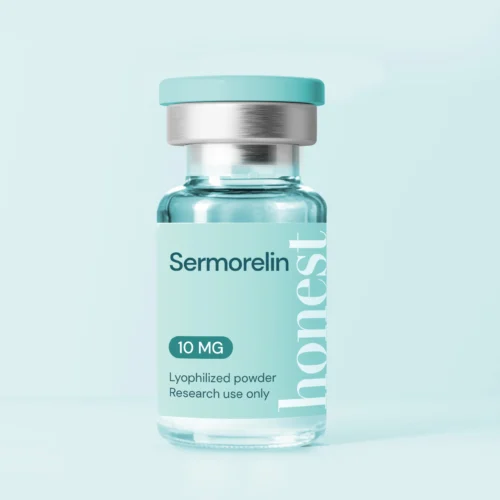
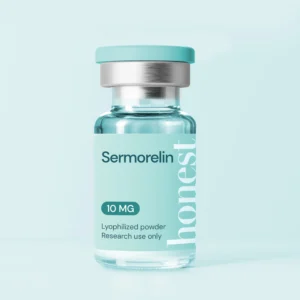
Sermorelin is a synthetic peptide corresponding to the first 29 amino acids of human growth hormone–releasing hormone studied in controlled research environments. Researchers use this compound to investigate GHRH receptor activity, pituitary responsiveness, and the regulation of growth hormone secretion.
Synthetic 29-amino-acid GHRH peptide
Studied in research involving GHRH receptor signaling
Used in pituitary and growth hormone research models
Supplied as a purified lyophilized powder for controlled laboratory research
Identity (M-S) passed
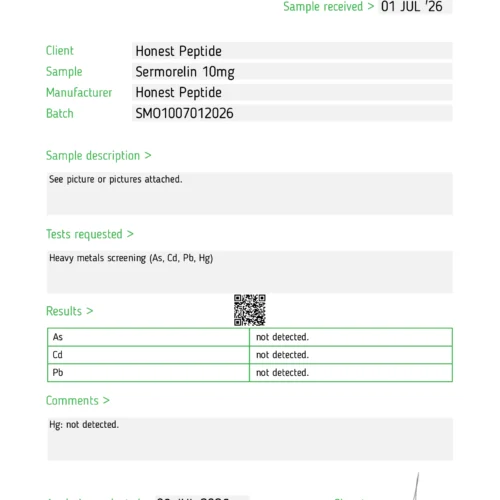
Heavy metals cleared
Purity (HPLC) Passed
Volume pricingSave up to 15% with quantity-based pricing. Discounts are applied automatically in cart.
Quantity
Discount
Per item price
1Current Tier
0%
$59.00
2 - 5Current Tier
5%
$56.05
6 - 10Current Tier
10%
$53.10
11 - 15Current Tier
15%
$50.15
Volume pricingSave up to 15% with quantity-based pricing. Discounts are applied automatically in cart.
Quantity
Discount
Per item price
1Current Tier
0%
$59.00
2 - 5Current Tier
5%
$56.05
6 - 10Current Tier
10%
$53.10
11 - 15Current Tier
15%
$50.15
Product SpecificationsSequence, molecular weight, appearance, and analytical
A documented, step-by-step process designed to ensure consistency, transparency, and traceability
Sampled
Representative samples are selected from each production lot
Independently Tested
Samples are submitted to a qualified third-party laboratory for analytical testing
Reviewed
Analytical results are reviewed against our internal release specifications
Published
Results and supporting documentation are published online before shipment
Research
Scientific Overview
Explore key technical details, molecular characteristics, and research context for this compound.
What Is Sermorelin?
Sermorelin’s history begins with the 1982 isolation and sequencing of human growth hormone–releasing hormone from pancreatic tumors associated with acromegaly.¹ ² This discovery allowed researchers to identify which portion of the 44-amino-acid hormone was required to stimulate pituitary growth hormone release. During the early 1980s, shorter fragments were synthesized and tested. The first 29 amino acids retained substantial biological activity, leading to development of GHRH(1-29)-NH₂, later known as sermorelin.³ ⁴ Human studies showed that the fragment could stimulate growth hormone release while providing a tool for assessing pituitary responsiveness.⁴–⁸ Sermorelin was subsequently developed for diagnostic and pediatric endocrine use. It received U.S. approval in 1997 for evaluating and treating certain forms of childhood growth hormone deficiency, then was withdrawn from the market in 2008 for commercial rather than newly identified safety reasons.⁹ Its historical importance lies in connecting the discovery of GHRH with a practical test of endogenous pituitary function. Current research-grade sermorelin should not be treated as equivalent to a regulated prescription product.
Sermorelin reproduces the active 1–29 region of GHRH and binds GHRH receptors on somatotroph cells in the anterior pituitary. Receptor activation stimulates adenylyl cyclase, increases intracellular cyclic AMP and activates signaling that supports growth hormone synthesis and release.¹⁰ The resulting growth hormone response is pulsatile rather than a direct replacement of circulating hormone. Human research found that GHRH(1-29)-based stimulation could produce discrete growth hormone pulses, reflecting the pituitary’s existing secretory capacity.⁸ Released growth hormone acts on the liver and other tissues to increase downstream IGF-1 signaling.¹¹ Because sermorelin works upstream, its response remains shaped by endogenous regulators, including inhibitory somatostatin and feedback from growth hormone and IGF-1.¹² Sermorelin therefore depends on a functioning pituitary and does not reproduce the pharmacology of recombinant growth hormone. Its short exposure produces a temporary receptor signal, making it useful for studying the timing, reserve capacity and feedback regulation of the GH–IGF-1 axis.
Sermorelin, ipamorelin and tesamorelin all influence the growth hormone axis, but they differ in structure, receptor target and evidence base. Sermorelin is a 29-amino-acid GHRH fragment that activates pituitary GHRH receptors and is historically associated with testing pituitary growth hormone reserve.¹⁰ Ipamorelin is a five-amino-acid growth hormone secretagogue that activates the ghrelin receptor, GHSR-1a. Early research emphasized its ability to stimulate growth hormone with comparatively limited ACTH and cortisol responses.¹³ Tesamorelin is a modified, full-length 44-amino-acid GHRH analog. Like sermorelin, it activates the GHRH receptor, but its N-terminal modification improves stability. It also has a distinct clinical history: a regulated tesamorelin drug is FDA-approved to reduce excess abdominal fat in adults with HIV-associated lipodystrophy.¹⁴ The clearest comparison is therefore pathway and development: sermorelin is the shorter classic GHRH fragment, ipamorelin uses the ghrelin-receptor pathway, and tesamorelin is a stabilized full-length GHRH analog with indication-specific clinical evidence. These differences do not make one compound universally preferable for research.
Rivier J, Spiess J, Thorner MO, Vale W. Characterization of a growth hormone-releasing factor from a human pancreatic islet tumour. Nature. 1982;300(5889):276-278. Original publication.
Guillemin R, Brazeau P, Bohlen P, et al. Growth hormone-releasing factor from a human pancreatic tumor that caused acromegaly. Science. 1982;218(4572):585-587. Original publication.
Thorner MO, Rivier J, Spiess J, Vance ML, Vale W. Human pancreatic growth-hormone-releasing factor (hpGRF-40) selectively stimulates GH secretion in normal men. Lancet. 1983;1(8321):24-28. Original publication.
Barron JL, Hopkins KD, Dunger DB, Hesp R, White A. GHRH(1-29)-NH₂ and a D-Ala² analog are potent stimulators of GH release in normal men. Clin Endocrinol (Oxf). 1985;23(4):399-407. Original publication.
Kopelman PG, Noonan K, Ginsburg J, White N. Low-dose GHRH(1-29)-NH₂ bolus and pulsed infusions: GH responses in normal-weight vs obese women. Clin Sci (Lond). 1986;70(5):531-538. Original publication.
Vance ML, Kaiser DL, Frohman LA, et al. [Nle²⁷]GHRH(1-29)-NH₂ in normal men: IV, SC, and intranasal dosing stimulates GH without adverse effects. J Clin Endocrinol Metab. 1986;62(6):1242-1247. Original publication.
Losa M, Schopohl J, von Werder K. Stimulation of GH with human GRF1-44, GRF1-40, and GRF1-29 in normal subjects (single-dose comparison). Klin Wochenschr. 1984;62(23):1109-1113. Original publication.
Merimee TJ, Furlanetto R, et al. Pulsatile GH secretion induced by GHRH(1-29)-NH₂ (sermorelin) in man. J Clin Endocrinol Metab. 1988;66(3):541-544. Original publication.
Prakash A, Goa KL. Sermorelin: review of diagnostic and therapeutic use (pediatric GH deficiency; dosing/response). BioDrugs. 1999;12(6):419-436. Original publication.
Thorner MO, et al. Sermorelin: a growth hormone–releasing hormone analog. J Clin Endocrinol Metab. 1986;62(4):648–653. Original publication.
Sonntag WE, et al. Effects of growth hormone and IGF-1 on cognitive function in aging. Prog Neurobiol. 2005;75(6):787–811. Original publication.
Walker RF, et al. Stimulation of growth hormone secretion by Sermorelin in humans. Endocr Rev. 1994;15(1):1–14. Original publication.
Svensson J, et al. Ipamorelin, a new growth hormone releasing peptide in humans. J Clin Endocrinol Metab. 2000;85(1): 282–288. Original publication.
Falutz J, et al. Effects of tesamorelin, a growth hormone–releasing factor analog, in HIV patients with abdominal fat accumulation. N Engl J Med. 2007;357(23):2359–2370. Original publication.
Information
Product FAQs
Answers to common questions about research use, testing, storage, ordering, and documentation.
What does Sermorelin look like?
Sermorelin is supplied as a dry, lyophilized (freeze-dried) powder and should be white in color. If the material appears inconsistent with its documented specifications, contact our team for verification.
How is Sermorelin tested?
Every batch undergoes independent third-party analytical testing. Testing includes mass spectrometry for identity, HPLC for purity, net peptide content, heavy metals, fentanyl screening, and endotoxin testing. Full results are published in the applicable batch-specific COA or laboratory report.
What quality standards must Sermorelin meet?
Every batch must meet our release specifications before being made available for sale: confirmed molecular identity, ≥99% HPLC purity, peptide content no more than 10% below the stated amount, and successful completion of all applicable contaminant testing.
How can I verify my Sermorelin batch and access its Certificate of Analysis (COA)?
Locate the batch number printed on your product box, then scan the QR code on the vial to access our COA Library and find the matching report. Batch-specific COAs are also available directly on the product page. Each report contains independent third-party testing results, and previous batch reports are retained for historical reference
Does Sermorelin come with a solvent or other accessories?
No. Sermorelin is sold individually and does not include solvents or other accessories.
How should Sermorelin be stored?
Sermorelin should be kept tightly sealed and protected from moisture, light, and repeated temperature fluctuations. For shorter-term storage, refrigeration at 2–8°C may be appropriate, while freezer storage at approximately −20°C may be appropriate for longer-term preservation.
When will my order ship?
Orders placed on weekdays before our daily shipping cutoff typically ship the same business day. Orders placed after the cutoff, on weekends, or on holidays typically ship the next business day. Tracking is emailed once your order ships.
What is your refund policy?
If there is a problem with your order, contact us within 30 days of delivery. Depending on the circumstances, we’ll arrange an appropriate replacement or refund.
This product is intended for qualified research use only.
Sale of this product is restricted to qualified researchers, laboratories, and research institutions. This material is supplied solely for controlled research use and is not intended for human consumption, veterinary use, therapeutic use, or clinical application. Purchase constitutes confirmation that the buyer is appropriately qualified and will use the material only for research purposes.


 Account


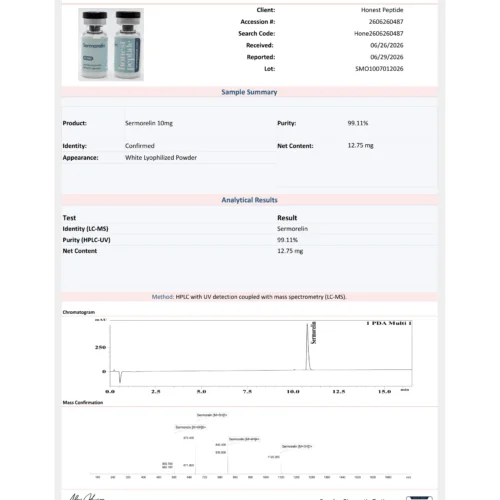
 Identity (M-S) passed
 Volume pricing
 Identity (M-S) passed