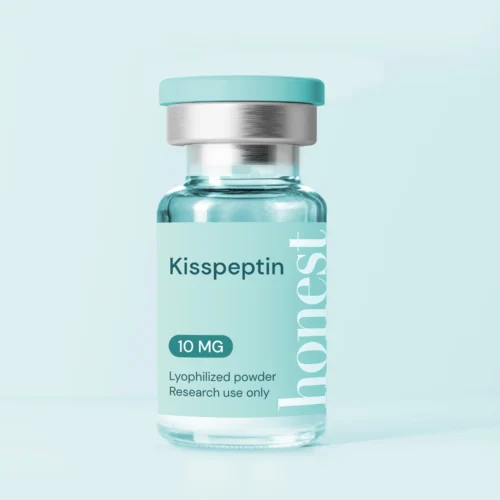
Kisspeptin refers to a family of KISS1-derived peptides studied in controlled research environments. Researchers use these peptides to investigate kisspeptin receptor signaling and its relationship to gonadotropin-releasing hormone secretion and reproductive endocrine regulation.
KISS1-derived peptide targeting the KISS1 receptor
Studied in research involving GnRH and gonadotropin signaling
Used in hypothalamic and reproductive endocrine research models
Supplied as a purified lyophilized powder for controlled laboratory research
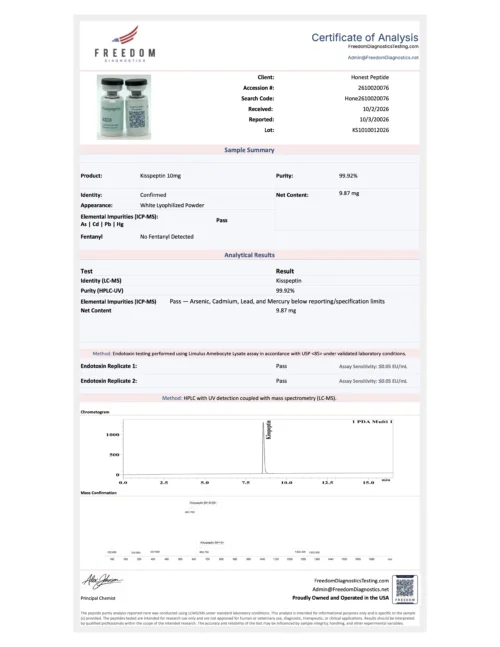
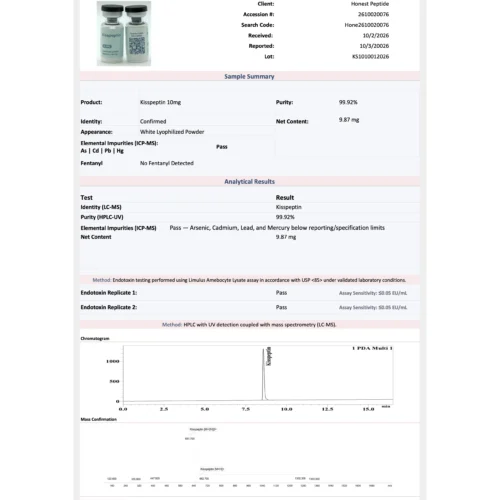
Endo test passed
Identity (M-S) passed
Heavy metals cleared
Fentanyl cleared
Purity (HPLC) Passed
Volume pricingSave up to 15% with quantity-based pricing. Discounts are applied automatically in cart.
Quantity
Discount
Per item price
1Current Tier
0%
$45.00
2 - 5Current Tier
5%
$42.75
6 - 10Current Tier
10%
$40.50
11 - 15Current Tier
15%
$38.25
Volume pricingSave up to 15% with quantity-based pricing. Discounts are applied automatically in cart.
Quantity
Discount
Per item price
1Current Tier
0%
$45.00
2 - 5Current Tier
5%
$42.75
6 - 10Current Tier
10%
$40.50
11 - 15Current Tier
15%
$38.25
Product SpecificationsSequence, molecular weight, appearance, and analytical
Amino Acid Sequence
Tyr-Asn-Trp-Asn-Ser-Phe-Gly-Leu-Arg-Phe-NH2
Molecular Formula
C₆₃H₈₃N₁₇O₁₄
Molecular Weight
~5,857.4 g/mol
PubChem CID
25240297
CAS Number
374675-21-5
Vial Size
3 mL
Contents
Lyophilized powder, white/off-white color
Shipping & Fulfillment
Same-Day Shipping: Orders placed before 10:00 AM ET on business days typically ship the same day.
U.S. Fulfillment: Orders ship from our East Coast warehouse.
Expedited Shipping: All orders ship via UPS 2-Day, FedEx 2-Day or USPS Priority
Free Shipping: Orders over $120 ship for free.
Tracking: Tracking information is provided once your order ships.
Discreet Packaging: Orders are shipped in secure, plain outer packaging.
Storage & handlingStorage conditions, handling precautions, temperature, and stability guidance.
Storage:
Store the lyophilized vial in a cool, dry area protected from direct sunlight.
Kisspeptin
1 item selected
Testing
Current Batch Verification
Review current lot-specific analytical results and supporting documentation for each available strength.
A documented, step-by-step process designed to ensure consistency, transparency, and traceability
Sampled
Representative samples are selected from each production lot
Independently Tested
Samples are submitted to a qualified third-party laboratory for analytical testing
Reviewed
Analytical results are reviewed against our internal release specifications
Published
Results and supporting documentation are published online before shipment
Research
Scientific Overview
Explore key technical details, molecular characteristics, and research context for this compound.
What Is Kisspeptin?
Kisspeptin refers to a family of naturally occurring peptides produced from the human KISS1 gene. Its research history began with the identification of KISS1 in melanoma metastasis studies, before researchers discovered that its peptide products activate the receptor now called KISS1R, formerly GPR54.¹ ² The best-studied forms, kisspeptin-54 and kisspeptin-10, share a receptor-activating C-terminal sequence but differ in length and biological exposure.² Human genetic studies later linked impaired KISS1R function to disrupted puberty, establishing the pathway’s importance in reproductive development.³ Clinical research subsequently examined gonadotropin secretion, reproductive-hormone responses and experimental oocyte maturation during IVF.⁴ ⁵ These findings place kisspeptin upstream of GnRH, LH and FSH rather than identifying it as a replacement for those hormones. Kisspeptin remains investigational, and findings for one peptide form or study population should not automatically be generalized to another. Its history therefore connects an initial discovery in cancer biology with a well-supported role in reproductive signaling and continuing investigation of potential clinical applications.
Kisspeptin binds KISS1R, a G-protein-coupled receptor expressed by many gonadotropin-releasing hormone neurons in the hypothalamus.² ⁶ Receptor activation primarily engages Gq/11 proteins and phospholipase C, generating intracellular signals that involve IP3, calcium and changes in membrane ion-channel activity. These processes excite GnRH neurons and support GnRH release, with the detailed cellular evidence drawn mainly from animal experiments.⁷ GnRH then enters the hypothalamic-pituitary portal circulation and stimulates anterior-pituitary gonadotrophs to release LH and FSH. Those hormones subsequently act on the ovaries or testes. Human studies support downstream gonadotropin responses, while their magnitude depends on peptide form, reproductive state and administration pattern.⁴ Frequent repeated administration has also produced diminished responses in a small clinical study.⁸ Kisspeptin therefore follows the pathway KISS1R → Gq/11–PLC/calcium signaling → GnRH → LH and FSH → gonadal responses. Its action depends on a responsive reproductive axis and operates within a system shaped by hormonal feedback and pulsatile signaling.
Lee JH, Miele ME, Hicks DJ, et al. KiSS-1, a novel human malignant melanoma metastasis-suppressor gene. Journal of the National Cancer Institute. 1996;88:1731–1737. Original publication.
Kotani M, Detheux M, Vandenbogaerde A, et al. The metastasis suppressor gene KiSS-1 encodes kisspeptins, the natural ligands of the orphan G protein-coupled receptor GPR54. Journal of Biological Chemistry. 2001;276:34631–34636. Original publication.
Seminara SB, Messager S, Chatzidaki EE, et al. The GPR54 gene as a regulator of puberty. New England Journal of Medicine. 2003;349:1614–1627. Original publication.
Dhillo WS, Chaudhri OB, Patterson M, et al. Kisspeptin-54 stimulates the hypothalamic-pituitary gonadal axis in human males. Journal of Clinical Endocrinology & Metabolism. 2005;90:6609–6615. Original publication.
Jayasena CN, Abbara A, Comninos AN, et al. Kisspeptin-54 triggers egg maturation in women undergoing in vitro fertilization. Journal of Clinical Investigation. 2014;124:3667–3677. Original publication.
Messager S, Chatzidaki EE, Ma D, et al. Kisspeptin directly stimulates gonadotropin-releasing hormone release via G protein-coupled receptor 54. Proceedings of the National Academy of Sciences USA. 2005;102:1761–1766. Original publication.
Liu X, Lee K, Herbison AE. Kisspeptin excites gonadotropin-releasing hormone neurons through a phospholipase C/calcium-dependent pathway regulating multiple ion channels. Endocrinology. 2008;149:4605–4614. Original publication.
Jayasena CN, Nijher GMK, Chaudhri OB, et al. Subcutaneous injection of kisspeptin-54 acutely stimulates gonadotropin secretion in women with hypothalamic amenorrhea, but chronic administration causes tachyphylaxis. Journal of Clinical Endocrinology & Metabolism. 2009;94:4315–4323. Original publication.
Information
Product FAQs
Answers to common questions about research use, testing, storage, ordering, and documentation.
How is Kisspeptin tested?
Every batch undergoes independent third-party analytical testing. Depending on the product, testing includes mass spectrometry for identity, HPLC for purity, net peptide content, heavy metals, fentanyl screening, and endotoxin testing. Full results are published in the applicable batch-specific COA or laboratory report.
What quality standards must a batch meet?
Every batch must meet our release specifications before being made available for sale: confirmed molecular identity, ≥99% HPLC purity, peptide content no more than 10% below the stated amount, and successful completion of all applicable contaminant testing.
How do I access batch-specific COAs?
Testing documentation is available directly on the applicable product page and through our COA Library. Each report corresponds to a specific batch or lot, and we retain testing from previous batches for historical reference.
When will my order ship?
Orders placed on weekdays before our daily shipping cutoff typically ship the same business day. Orders placed after the cutoff, on weekends, or on holidays typically ship the next business day. Tracking is emailed once your order ships.
What is your refund policy?
If there is a problem with your order, contact us within 30 days of delivery. Depending on the circumstances, we’ll arrange an appropriate replacement or refund.
How should lyophilized peptides be stored?
Storage requirements vary by compound. For long-term storage, many lyophilized peptides are stored sealed at approximately –20 °C, protected from moisture and light. Refer to the applicable product page for product-specific guidance.
This product is intended for qualified research use only.
Sale of this product is restricted to qualified researchers, laboratories, and research institutions. This material is supplied solely for controlled research use and is not intended for human consumption, veterinary use, therapeutic use, or clinical application. Purchase constitutes confirmation that the buyer is appropriately qualified and will use the material only for research purposes.


 Account
 Endo test passed
 Volume pricing
 Endo test passed