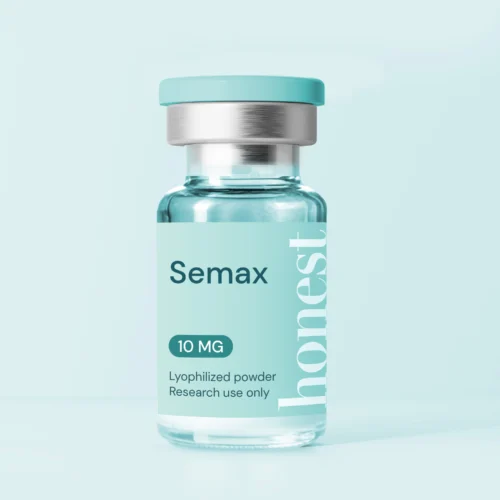
Semax is a synthetic heptapeptide analogue of an adrenocorticotropic hormone fragment studied in controlled laboratory environments. Researchers use this compound to investigate neuronal signaling, peptide–metal interactions, and cellular responses to experimental stress.
Synthetic heptapeptide based on an ACTH-derived sequence
Studied in research involving neuronal responses and copper-associated pathways
Used in neuronal and cellular stress research models
Supplied as a purified lyophilized powder for controlled laboratory research
Identity (M-S) passed
Heavy metals cleared
Purity (HPLC) Passed
Volume pricingSave up to 15% with quantity-based pricing. Discounts are applied automatically in cart.
Quantity
Discount
Per item price
1Current Tier
0%
$49.00
2 - 5Current Tier
5%
$46.55
6 - 10Current Tier
10%
$44.10
11 - 15Current Tier
15%
$41.65
Volume pricingSave up to 15% with quantity-based pricing. Discounts are applied automatically in cart.
Quantity
Discount
Per item price
1Current Tier
0%
$49.00
2 - 5Current Tier
5%
$46.55
6 - 10Current Tier
10%
$44.10
11 - 15Current Tier
15%
$41.65
Product SpecificationsSequence, molecular weight, appearance, and analytical
Amino Acid Sequence
H-Met-Glu-His-Phe-Pro-Gly-Pro-OH
Molecular Formula
C37H51N9O10S
Molecular Weight
~813.9 g/mol
PubChem CID
9811102
CAS Number
80714-61-0
Vial Size
3 mL
Contents
Lyophilized powder, white/off-white color
Shipping & Fulfillment
Same-Day Shipping: Orders placed before 10:00 AM ET on business days typically ship the same day.
U.S. Fulfillment: Orders ship from our East Coast warehouse.
Expedited Shipping: All orders ship via UPS 2-Day, FedEx 2-Day or USPS Priority
Free Shipping: Orders over $120 ship for free.
Tracking: Tracking information is provided once your order ships.
Discreet Packaging: Orders are shipped in secure, plain outer packaging.
Storage & handlingStorage conditions, handling precautions, temperature, and stability guidance.
Storage:
Store the lyophilized vial in a cool, dry area protected from direct sunlight.
Semax
1 item selected
Testing
Current Batch Verification
Review current lot-specific analytical results and supporting documentation for each available strength.
A documented, step-by-step process designed to ensure consistency, transparency, and traceability
Sampled
Representative samples are selected from each production lot
Independently Tested
Samples are submitted to a qualified third-party laboratory for analytical testing
Reviewed
Analytical results are reviewed against our internal release specifications
Published
Results and supporting documentation are published online before shipment
Research
Scientific Overview
Explore key technical details, molecular characteristics, and research context for this compound.
What Is Semax?
Semax was developed through Russian peptide research programs examining short fragments of adrenocorticotropic hormone, or ACTH. Researchers were interested in whether neurological activity associated with ACTH fragments could be separated from the adrenal-stimulating effects of the full 39-amino-acid hormone.¹ The resulting seven-amino-acid peptide combines the ACTH(4-7) sequence, Met-Glu-His-Phe, with Pro-Gly-Pro. It is often described as an ACTH(4-10) analog, although it is not the same sequence: Semax replaces the Arg-Trp-Gly portion of natural ACTH(4-10) with Pro-Gly-Pro. This modification was designed to improve resistance to enzymatic degradation.¹ ² Research subsequently expanded into cognition, cerebral ischemia, neurotrophin signaling and neuroinflammation. Human studies have examined neurological rehabilitation and cognitive settings, but the clinical literature remains smaller and less independently replicated than the preclinical literature. Semax is historically significant as an attempt to create a stabilized, non-corticotropic ACTH-derived regulatory peptide. It is not equivalent to ACTH, and it is not FDA-approved for therapeutic use in the United States.
Semax does not have one conclusively identified primary receptor. Experimental research instead supports time-dependent and brain-region-specific effects across several neurological pathways. The most studied pathway involves BDNF and its receptor TrkB. Rodent studies have reported changes in BDNF expression, BDNF protein and TrkB expression or activation after Semax exposure.³ These findings suggest modulation of the BDNF signaling environment; they do not show that Semax binds directly to TrkB. Specific binding has been reported in rat basal-forebrain tissue, but the responsible binding protein was not identified.⁴ Other animal studies have found region-specific changes in dopamine and serotonin systems, along with changes in NGF, NT-3 and injury-responsive gene expression.⁵–⁸ In cell and cerebral-ischemia models, researchers have also examined calcium regulation, mitochondrial membrane stability, oxidative signaling and inflammatory gene networks.⁹–¹¹ These observations should not be collapsed into one proven linear cascade. Semax is therefore best described as a multi-pathway regulatory peptide. Most detailed mechanism evidence remains preclinical, and a complete human mechanism has not been established.
Deigin VI, Poluektova EA, Beniashvili AG, Kozin SA, Poluektov YM. Development of peptide biopharmaceuticals in Russia. Pharmaceutics. 2022;14(4):716. Original publication.
Potaman VN, Alfeeva LY, Kamensky AA, Levitskaya NG, Nezavibatko VN. N-terminal degradation of ACTH (4-10) and its synthetic analog Semax by rat blood enzymes. Biochemical and Biophysical Research Communications. 1991;176(2):741–746. Original publication.
Dolotov OV, Karpenko EA, Inozemtseva LS, et al. Semax, an analog of ACTH (4-10) with cognitive effects, regulates BDNF and TrkB expression in the rat hippocampus. Brain Research. 2006;1117(1):54–60. Original publication.
Dolotov OV, Karpenko EA, Seredenina TS, et al. Semax, an analogue of adrenocorticotropin (4-10), binds specifically and increases levels of brain-derived neurotrophic factor protein in rat basal forebrain. Journal of Neurochemistry. 2006;97(Suppl 1):82–86. Original publication.
Dmitrieva VG, Povarova OV, Skvortsova VI, Limborska SA, Myasoedov NF, Dergunova LV. Semax and Pro-Gly-Pro activate the transcription of neurotrophins and their receptor genes after cerebral ischemia. Cellular and Molecular Neurobiology. 2010;30(1):71–79. Original publication.
Eremin KO, Kudrin VS, Saransaari P, et al. Semax, an ACTH (4-10) analogue with nootropic properties, activates dopaminergic and serotoninergic brain systems in rodents. Neurochemical Research. 2005;30(12):1493–1500. Original publication.
Medvedeva EV, Dmitrieva VG, Povarova OV, et al. The peptide Semax affects the expression of genes related to the immune and vascular systems in rat brain focal ischemia: genome-wide transcriptional analysis. BMC Genomics. 2014;15:228. Original publication.
Filippenkov IB, Stavchansky VV, Denisova AE, et al. Novel insights into the protective properties of ACTH (4-7) PGP (Semax) peptide at the transcriptome level following cerebral ischaemia-reperfusion in rats. Genes. 2020;11(6):681. Original publication.
Sudarkina OY, Filippenkov IB, Stavchansky VV, et al. Brain protein expression profile confirms the protective effect of the ACTH (4-7) PGP peptide Semax in a rat model of cerebral ischemia-reperfusion. International Journal of Molecular Sciences. 2021;22(12):6179. Original publication.
Storozhevykh TP, Tukhbatova GR, Senilova YE, Pinelis VG, Andreeva LA, Myasoedov NF. Effects of Semax and its Pro-Gly-Pro fragment on calcium homeostasis of neurons and their survival under conditions of glutamate toxicity. Bulletin of Experimental Biology and Medicine. 2007;143(5):601–604. Original publication.
Bashkatova VG, Koshelev VB, Fadyukova OE, et al. Novel synthetic analogue of ACTH 4-10 (Semax) but not glycine prevents the enhanced nitric oxide generation in cerebral cortex of rats with incomplete global ischemia. Brain Research. 2001;894(1):145–149. Original publication.
Information
Product FAQs
Answers to common questions about research use, testing, storage, ordering, and documentation.
What does Semax look like?
Semax is supplied as a dry, lyophilized (freeze-dried) powder and should be white in color. If the material appears inconsistent with its documented specifications, contact our team for verification.
How is Semax tested?
Every batch undergoes independent third-party analytical testing. Testing includes mass spectrometry for identity, HPLC for purity, net peptide content, heavy metals, fentanyl screening, and endotoxin testing. Full results are published in the applicable batch-specific COA or laboratory report.
What quality standards must Semax meet?
Every batch must meet our release specifications before being made available for sale: confirmed molecular identity, ≥99% HPLC purity, peptide content no more than 10% below the stated amount, and successful completion of all applicable contaminant testing.
How can I verify my Semax batch and access its Certificate of Analysis (COA)?
Locate the batch number printed on your product box, then scan the QR code on the vial to access our COA Library and find the matching report. Batch-specific COAs are also available directly on the product page. Each report contains independent third-party testing results, and previous batch reports are retained for historical reference
Does Semax come with a solvent or other accessories?
No. Semax is sold individually and does not include solvents or other accessories.
How should Semax be stored?
Semax should be kept tightly sealed and protected from moisture, light, and repeated temperature fluctuations. For shorter-term storage, refrigeration at 2–8°C may be appropriate, while freezer storage at approximately −20°C may be appropriate for longer-term preservation.
When will my order ship?
Orders placed on weekdays before our daily shipping cutoff typically ship the same business day. Orders placed after the cutoff, on weekends, or on holidays typically ship the next business day. Tracking is emailed once your order ships.
What is your refund policy?
If there is a problem with your order, contact us within 30 days of delivery. Depending on the circumstances, we’ll arrange an appropriate replacement or refund.
This product is intended for qualified research use only.
Sale of this product is restricted to qualified researchers, laboratories, and research institutions. This material is supplied solely for controlled research use and is not intended for human consumption, veterinary use, therapeutic use, or clinical application. Purchase constitutes confirmation that the buyer is appropriately qualified and will use the material only for research purposes.


 Account


 Identity (M-S) passed
 Volume pricing
 Identity (M-S) passed