Tesamorelin Dosage Calculator
This Tesamorelin dosage calculator estimates syringe units, concentration, vial yield, and how long a vial will last based on vial size, water volume, and amount per dose
Common Tesamorelin parameters are pre-selected for faster calculation.
Go to peptide-specific calculator ↓
Result
To have a dose of 1mg pull the syringe to 0

Your vial contains
0.0 dosesConcentration
0.0 mg/mLYour vial will last —
Select Your Specific Peptide
Reconstitution guide
Use our Peptide Calculator below to calculate accurate dosages foradministering peptides using a syringe.
STEP 1
Set your dose
Choose your intended dose in micrograms (mcg): This is the amount of peptide you plan to inject each time.
STEP 2
Enter your peptide strength
Enter the peptide strength in your vial. You can select a common amount, such as 1mg, 5mg, 10mg, or 15mg. If your amount isn’t listed, you can manually type in the exact amount.
STEP 3
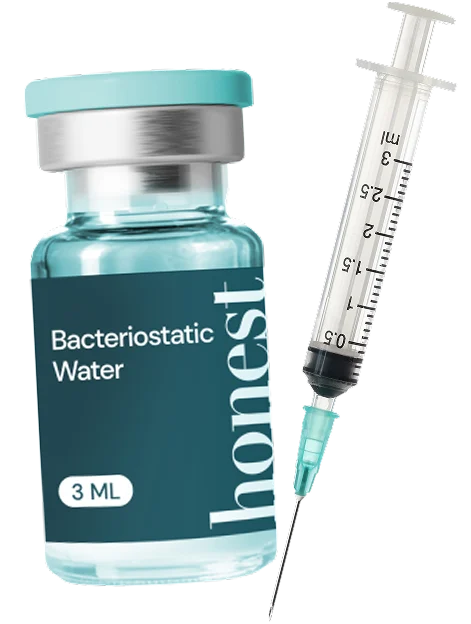
Add your water volume
The volume of water you add affects the concentration of the peptide solution. Enter the amount of water in milliliters (mL).
Tesamorelin Dosage: What the research says
This information is based on preclinical and clinical research studies. Tesamorelin is not FDA-approved for human use. This content is for research and informational purposes only
Common Research Doses
The presets in our calculator reflect the amounts most clearly represented in tesamorelin dose-ranging studies, Phase III trials, and formulation-specific clinical labeling.
- Low (1mg): The lower amount evaluated in early dose-ranging research. In a 12-week placebo-controlled study, both 1mg and 2mg increased IGF-1, but reductions in trunk fat and improvements in several lipid measures were more pronounced at 2mg.¹ A later randomized study in participants with type 2 diabetes also evaluated 1mg and 2mg daily for 12 weeks.²
- Mid (1.4mg): The labeled once-daily amount for the EGRIFTA SV formulation. Pharmacokinetic testing found that 1.4mg of EGRIFTA SV produced systemic exposure comparable to the older 2mg EGRIFTA formulation. This amount is formulation-specific and should not be interpreted as universally interchangeable with 1.4mg of every tesamorelin preparation.³
- High (2mg): The amount used in the major 26- and 52-week Phase III studies investigating visceral adipose tissue in adults with HIV-associated lipodystrophy. It is the most extensively studied fixed daily amount in the published tesamorelin literature.⁴⁵
Frequency of Administration
Tesamorelin has been administered once daily across the major dose-ranging studies, Phase III trials, metabolic studies, and current FDA-approved formulations. Daily administration was used in the 1mg and 2mg dose-ranging research, the 26-week pivotal trials, and the 52-week safety extensions.¹⁴⁵ The FDA-approved EGRIFTA SV and EGRIFTA WR formulations are also labeled for once-daily administration, although their recommended amounts differ because the formulations have different pharmacokinetic characteristics.³⁶
Route of Administration
Tesamorelin research includes several distinct study lengths depending on the endpoint.
- Short pharmacokinetic studies: Repeated 1mg or 2mg subcutaneous amounts have been evaluated over approximately 14 consecutive days to characterize growth hormone and IGF-1 responses.⁷
- Dose-ranging studies: Early clinical research evaluated 1mg and 2mg daily over approximately 12 weeks, measuring IGF-1, trunk fat, visceral fat, lipid parameters, glucose, and tolerability.¹²
- Phase III studies: The main pivotal trials administered 2mg daily for 26 weeks, followed by an additional 26-week extension for a total of 52 weeks in continuing participants. Reductions in visceral adipose tissue were maintained during continued treatment but were not sustained after tesamorelin was withdrawn.⁴⁵
- Liver-fat studies: Separate research evaluated daily tesamorelin for approximately six months, reporting reductions in visceral adipose tissue and modest reductions in liver fat in adults with HIV and abdominal fat accumulation.⁸
Study Duration
DSIP research generally follows acute timelines, focusing on immediate electrophysiological and hormonal shifts:
- Acute Sleep Models: 1 to 7 days is the standard timeline for observing immediate changes in EEG patterns, specifically the increase in deep slow-wave sleep (DSWS) and the reduction of sleep onset latency.⁴
- Sub-Acute Stress Models: 2 to 4 weeks when tracking the peptide’s cumulative effect on hormonal normalization, such as the blunting of corticotropin-releasing factor (CRF) and cortisol/corticosterone in chronic stress environments.¹
Evidence Limitations
Tesamorelin has substantially stronger clinical evidence than many research peptides, but that evidence applies to a narrow population and indication.
Tesamorelin is FDA-approved to reduce excess abdominal fat in adults with HIV-associated lipodystrophy. It is not indicated for general weight-loss management, and the FDA label describes it as weight neutral. Its long-term cardiovascular safety has not been established.³⁶
Most large trials studied 2mg daily in adults with HIV receiving antiretroviral therapy. Those results cannot automatically be generalized to obesity, bodybuilding, athletic performance, healthy aging, or unrelated metabolic conditions. Although a 12-week trial in participants with type 2 diabetes did not show loss of glycemic control, the approved labeling still warns that glucose intolerance or diabetes may develop.²³
Tesamorelin increases endogenous growth hormone and IGF-1. Relevant limitations and safety concerns include persistent IGF-1 elevation, fluid retention, arthralgia, carpal-tunnel-type symptoms, injection-site reactions, hypersensitivity, glucose intolerance, and concerns surrounding active or recurrent malignancy.³⁶
Scientific References
- Falutz J, Allas S, Kotler D, et al. A placebo-controlled, dose-ranging study of a growth hormone releasing factor in HIV-infected patients with abdominal fat accumulation. AIDS. 2005;19(12):1279–1287.
https://pubmed.ncbi.nlm.nih.gov/16052083/ - Clemmons DR, Miller S, Mamputu JC. Safety and metabolic effects of tesamorelin, a growth hormone-releasing factor analogue, in patients with type 2 diabetes: a randomized, placebo-controlled trial. PLoS ONE. 2017;12(6):e0179538.
https://pubmed.ncbi.nlm.nih.gov/28617838/
https://doi.org/10.1371/journal.pone.0179538 - U.S. Food and Drug Administration. EGRIFTA SV Prescribing Information.
https://www.accessdata.fda.gov/drugsatfda_docs/label/2019/022505s012s013lbl.pdf - Falutz J, Allas S, Blot K, et al. Metabolic effects of a growth hormone-releasing factor in patients with HIV. New England Journal of Medicine. 2007;357(23):2359–2370.
https://pubmed.ncbi.nlm.nih.gov/18057338/
https://www.nejm.org/doi/full/10.1056/NEJMoa072375 - Falutz J, Mamputu JC, Potvin D, et al. Effects of tesamorelin (TH9507), a growth hormone-releasing factor analog, in human immunodeficiency virus-infected patients with excess abdominal fat: a pooled analysis of two multicenter, double-blind, placebo-controlled Phase III trials with safety extension data. Journal of Clinical Endocrinology & Metabolism. 2010;95(9):4291–4304.
https://pubmed.ncbi.nlm.nih.gov/20554713/
https://academic.oup.com/jcem/article/95/9/4291/2835394 - U.S. Food and Drug Administration. EGRIFTA WR Prescribing Information. Revised March 2025.
https://www.accessdata.fda.gov/drugsatfda_docs/label/2025/022505s020lbl.pdf - González-Sales M, et al. Population pharmacokinetic and pharmacodynamic analysis of tesamorelin. 2015.
https://pubmed.ncbi.nlm.nih.gov/25895899/ - Stanley TL, Feldpausch MN, Oh J, et al. Effect of tesamorelin on visceral fat and liver fat in HIV-infected patients with abdominal fat accumulation: a randomized clinical trial. JAMA. 2014;312(4):380–389.
https://pubmed.ncbi.nlm.nih.gov/25038357/
https://jamanetwork.com/journals/jama/fullarticle/1889139 - Falutz J, Allas S, Mamputu JC, et al. Long-term safety and effects of tesamorelin, a growth hormone-releasing factor analogue, in HIV patients with abdominal fat accumulation. AIDS. 2008;22(14):1719–1728.
https://pubmed.ncbi.nlm.nih.gov/18690162/
Shop peptides